
Condo HVAC Myths Debunked for Toronto Residents
Debunking common condo HVAC myths in Toronto before winter: fan coils, heat pumps, thermostats, maintenance costs, and what actually works.
- Hudson HVAC
- 16 min read
Condo HVAC Myths Debunked for Toronto Residents
Quick summary: A surprising number of Toronto condo heating and cooling problems come from bad assumptions, not bad equipment. In fall, when buildings in Toronto, North York, and Mississauga start preparing for winter, these myths lead to delayed repairs, higher hydro bills, water leaks, and avoidable emergency calls.
Every October, Hudson HVAC starts seeing the same pattern across GTA high-rise condos: residents tolerate weak heat, noisy fan coils, long dryer cycles, and uneven temperatures because they believe something that simply is not true. This guide breaks down the 10 most common condo HVAC myths Hudson encounters in Toronto buildings and explains what actually happens inside fan coils, heat pumps, ERVs, and shared condo mechanical systems.
What makes condo HVAC different from house HVAC
Before getting into the myths, it helps to understand why condo advice online is often wrong. A detached house usually has one furnace, one AC, and one owner controlling the whole system. A condo is different: your suite-level equipment may depend on a central boiler loop, condenser water loop, chiller, make-up air unit, risers, or a seasonal building-wide changeover schedule. That is why house-HVAC tips from YouTube often do not apply to a 1998 North York high-rise or a newer glass tower in downtown Toronto.
In Hudson’s experience servicing more than 200 condo buildings, the biggest misunderstanding is not the equipment itself. It is the split between suite-side problems and building-side problems. A resident may replace a thermostat three times when the real issue is a stuck 3-way valve or low hot water temperature from the central plant. If your suite has not had in-suite HVAC maintenance, or your property manager has deferred mechanical maintenance, small issues tend to show up first during October and November when systems begin cycling more often.
Myth #1: “If air is blowing, the HVAC is working fine”
This is one of the most common hvac misconceptions in Toronto condos. Airflow only tells you the blower is moving air. It does not tell you whether the coil is receiving hot water, whether the heat pump is in heating mode, or whether the actuator has actually opened the valve.
In older Toronto and Etobicoke towers with vertical fan coils, Hudson often finds a blower that sounds normal but the discharge air is only 20-24°C when it should be closer to 30-38°C in heating season, depending on system design. The usual culprits are a failed actuator, a seized 3-way valve, air in the hydronic loop, or a heavily impacted coil acting like insulation. If your unit is blowing room-temperature air, that is not “better than nothing”; it is often a sign you need fan coil repair and replacement service, actuator replacement, or three-way valve replacement.
What to do right now
- Set the thermostat 2-3°C above room temperature.
- Let the unit run for 10 minutes.
- Hold your hand at the discharge grille.
- If the air still feels neutral instead of distinctly warm, the blower may be fine but the heating side is not.
That distinction matters, because residents often report “the fan works” and building staff assume the suite is okay.
Myth #2: “Turning the thermostat way up heats the condo faster”
Condo residents in Toronto, Vaughan, and Mississauga do this constantly in fall. The suite feels chilly in the morning, so the thermostat gets cranked to 28°C. On most fan coil systems, that does not increase heating output. It simply tells the unit to keep calling for heat until the room overshoots.
A condo thermostat is usually a control signal, not a throttle. On many Unilux, Honeywell, or Tekmar setups, the thermostat either energizes the fan and opens a valve, or it does not. The hot water temperature and coil capacity are determined by the building system. In practical terms, if the building loop is delivering 140°F water, the suite heats at the rate the coil and airflow allow. If the loop is delivering lukewarm water because the boiler reset schedule is wrong, setting the thermostat higher will not fix it.
This is why thermostat complaints should be diagnosed carefully. Sometimes the thermostat is bad and needs thermostat installation or replacement. But in our experience servicing Toronto condos, more often the thermostat is blamed for a valve or building-water-temperature issue.
Myth #3: “Condo HVAC doesn’t need maintenance unless it breaks”
This myth costs residents and boards real money. Preventive service in condos is less about “tune-up for performance” and more about catching failure patterns before they trigger leaks, no-heat calls, or occupant complaints during the first cold snap.
A fan coil that has not been serviced in 2-4 years usually shows a predictable set of issues:
- Dust-packed blower wheel reducing airflow by 15-30%
- Filter bypass because the wrong filter size was installed
- Condensate pan biofilm and rust starting at the back corners
- Actuator cycling repeatedly because the valve stem is stiff
- Blower motor capacitor weakening on PSC motors
- Electrical spade terminals discolored from heat
That is exactly why Hudson recommends annual fan coil maintenance or, for heat pump suites, scheduled heat pump maintenance before winter. In condo buildings from the late 80s and 90s, one missed maintenance cycle can turn a $250-$400 service issue into a $700-$1,200 repair once parts fail under load.
Myth #4: “All condos switch from cooling to heating the same way”
This is one of the least understood parts of condo heating cooling myths. Not all buildings operate the same, and the building age tells you a lot.
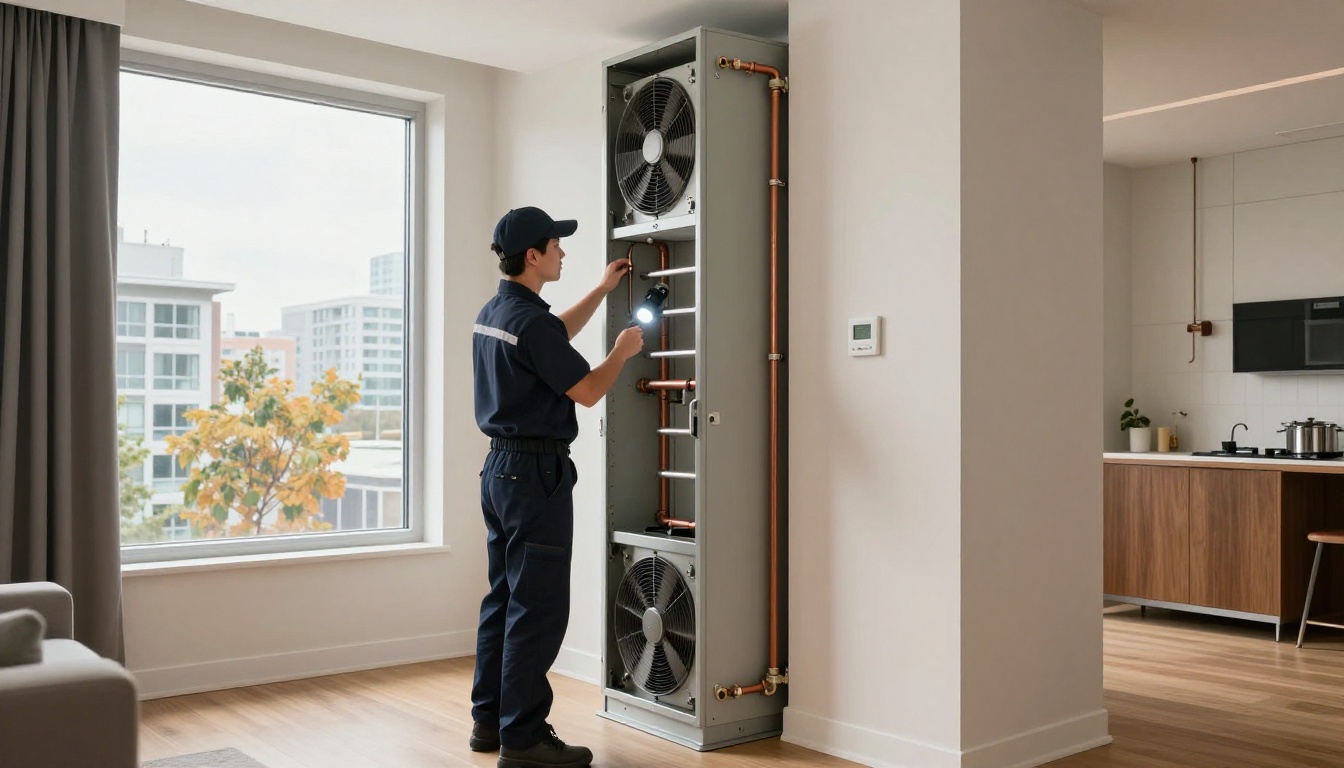
Many Toronto condo buildings built before roughly 2005 use 2-pipe systems, which means the same piping loop serves either heating or cooling depending on the season. Once the building changes over, your suite cannot independently demand the other mode. Newer buildings are more likely to use 4-pipe systems, where separate hot and chilled water loops allow simultaneous heating and cooling.
That is why a resident in a sun-exposed southwest corner suite in October may complain about overheating while a north-facing resident is asking for heat. In a 2-pipe building, management has to choose the season mode for everyone. Hudson sees this often in older North York and Mississauga towers where shoulder-season weather swings from 6°C mornings to 20°C afternoons.
If your board is dealing with chronic seasonal comfort complaints, it may not be a maintenance problem at all. It may be a system-limitation issue tied to original design. In those cases, longer-term planning around fan coil retrofit projects, heat pump replacement projects, or broader mechanical comprehensive maintenance becomes important.
Myth #5: “A noisy fan coil is annoying, but not urgent”
Noise is diagnostic data. A condo HVAC unit usually gets louder before it gets worse.
Here are a few sounds Hudson pays attention to:
- High-pitched whine: often worn blower motor bearings
- Click every 10-15 seconds: actuator trying and failing to seat
- Metal ticking during startup: cabinet expansion is normal; repeated sharp clicking from one point is not
- Buzzing near controls: relay or transformer issue
- Rattling at one fan speed only: loose blower wheel set screw or panel vibration
A blower motor that is starting to fail may still run for weeks, but amperage often climbs before total failure. In-suite motors for common condo fan coils typically range from 1/8 to 1/3 HP, and once bearings drag, winding temperature rises quickly in enclosed closets. A routine blower motor repair can prevent a no-heat call on the first weekend below freezing.
In Toronto high-rises, noise complaints also matter because residents often mistake mechanical noise for “pipe knocking” from the building. Sometimes it is, but quite often it is a suite-level issue that can be isolated in one visit.
Myth #6: “If there’s no leak, the drain pan is fine”
Fall is exactly when this myth causes winter headaches. Residents associate drain pans with summer cooling, but neglected pans and drains matter year-round because sludge, corrosion, and standing water create odor, mold, and eventual overflow risk.
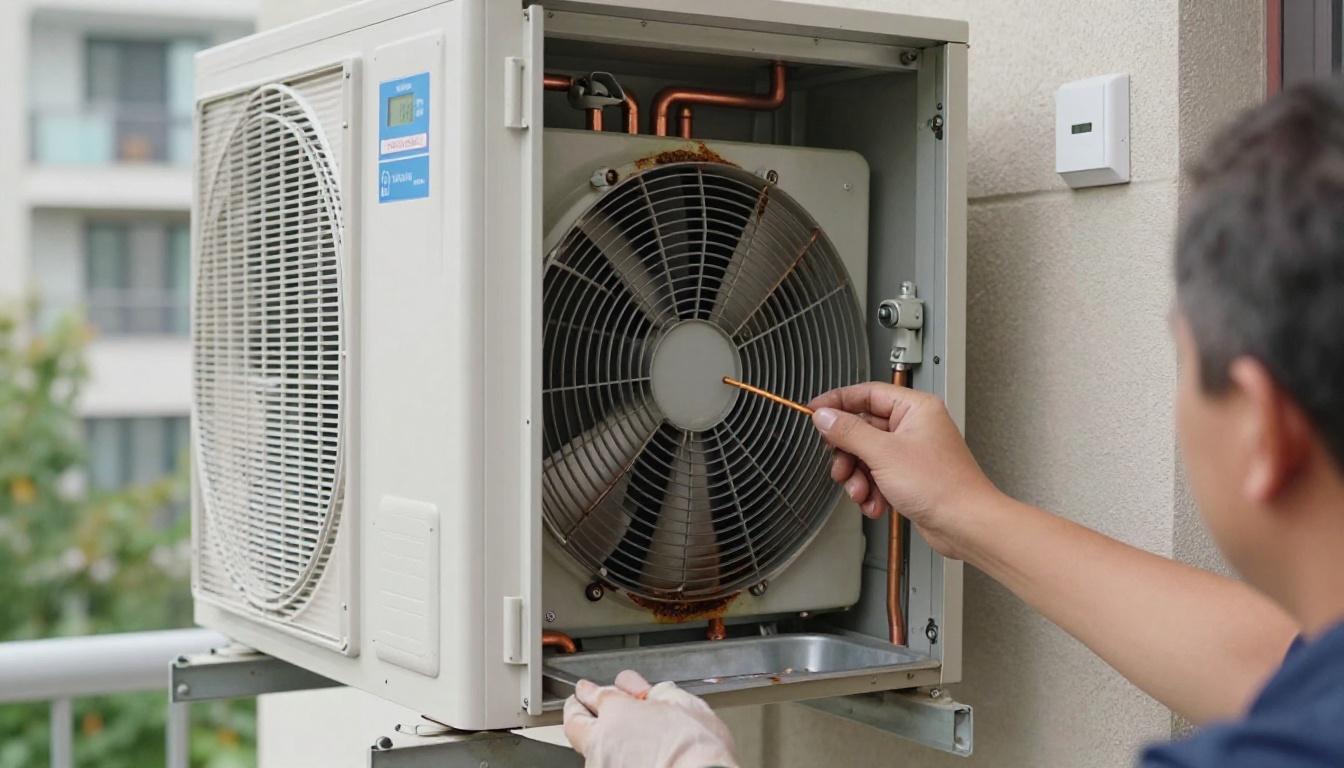
On fan coils in Toronto condos, the back half of the drain pan is often the most corroded part because it stays damp longest and is hardest to inspect without opening the cabinet. Hudson regularly finds pans that look acceptable from the front but have scale and pinhole rust at the rear seam. Once heating season begins, people forget about it until spring humidity returns and the first cooling cycle sends water where it should not go.
If you have musty air, visible rust flakes, or previous water staining around the unit, a drain pan cleaning and repair service is smarter than waiting. If there is visible biological growth, HVAC mold remediation may also be needed.
Myth #7: “My filter is clean enough if it doesn’t look black”
This is a classic condo myth because suite filters are small, easy to ignore, and often hidden behind a lower access panel. In many Toronto fan coils, the filter is a 1-inch or 2-inch pleated size, and even a light grey coating can reduce airflow enough to hurt heating performance.
Here is the practical test Hudson recommends:
- Remove the filter from the fan coil access panel.
- Hold it up to a bright light or a condo window.
- If you cannot clearly see light through most of the media, replace it.
- If the filter is bowed, damp, or installed backward, replace it regardless of appearance.
A dirty filter does more than reduce comfort. It can lower coil heat transfer, raise motor static pressure, and make residents think the building boiler is underperforming. For residents who have not had annual fan coil maintenance, this is the safest and most useful DIY step.
Myth #8: “Dryer vents have nothing to do with condo HVAC”
This is especially important in fall, because people close windows, run dryers more often, and start noticing humidity and stale air. In condo suites, ventilation problems are often blamed on the heating system when the dryer vent is the hidden issue.
Hudson has seen condo dryer vents in Toronto and North York where lint buildup extended drying times from 45 minutes to 90+ minutes. That extra moisture can spill into the suite, increasing humidity and making windows sweat during the first cold weeks of the season. Residents then assume the fan coil is “making the condo damp,” when the real problem is restricted exhaust.
Condo dryer vent systems also matter for safety and building operations. Long vertical runs, booster arrangements, and shared venting designs in some towers make proper cleaning more important than in a detached home. Scheduling dryer vent cleaning before winter is one of the simplest ways to reduce moisture complaints and shorten drying times.
Myth #9: “Ventilation equipment like ERVs is optional in a condo”
Many newer Toronto condos and some retrofit buildings use ERVs to exchange stale indoor air with fresh outdoor air while recovering some heat energy. When these units are neglected, residents often misdiagnose the symptoms as a heating problem: stuffy bedrooms, lingering cooking odours, window condensation, and uneven humidity.
One common mistake Hudson encounters is assuming the fan coil alone controls indoor air quality. It does not. A fan coil mainly handles sensible heating and cooling; it is not designed to bring in meaningful fresh air. If the ERV core is dirty, the filters are loaded, or the balancing is off, the suite can feel unhealthy even when the temperature is technically correct.
That is why fall is the right time for ERV maintenance, especially before Toronto’s winter windows-stay-closed season. In tighter new-build condominiums, neglected ventilation creates more complaints than the heating equipment itself.
Myth #10: “If one suite has a problem, it must be a building-wide issue”
Sometimes yes. Often no. This myth causes delays because residents wait for management to “fix the whole building” when the issue is sitting inside one suite cabinet.
A useful decision framework is this:
| Symptom | More likely suite-level | More likely building-level |
|---|---|---|
| One unit has no heat, neighbours are fine | Actuator, thermostat, blower motor, valve | Unlikely |
| Several stacks have weak heat | Possible riser balancing issue | Likely central loop or riser problem |
| Whole building changed from cooling to heating late | No | Yes |
| One suite has repeated leaks | Drain pan, trap, coil, insulation | Unlikely |
| Top floors are overheating while lower floors are cold | Rarely | Common hydronic balancing or control issue |
In condo operations, this distinction affects response time and cost. A suite-level repair can often be diagnosed in 60-90 minutes. A building-level issue may involve trend logs, boiler reset checks, balancing review, or central plant inspection under a comprehensive mechanical maintenance plan. Older towers may even need capital planning for riser replacement, boiler replacement, or related work shown on Hudson’s project portfolio.
What condo residents can safely do before calling for service
There are a few checks that are genuinely useful and safe:
- Check the thermostat setting and mode. Make sure it is on heat, not auto or cool, if your building has already switched over.
- Replace the filter. If accessible, use the correct size and airflow direction.
- Listen carefully. Note whether you hear fan noise, clicking, buzzing, or water sounds.
- Check for airflow at the grille. Weak airflow usually points to filter, blower, or coil issues.
- Look for visible water or rust. Do not remove sealed electrical covers.
- Ask one neighbour on your floor. If they have the same issue, it may be building-side.
If the unit is not responding, smells electrical, or is leaking, book emergency HVAC repair. For local condo-specific help, Hudson also has dedicated service pages for Toronto condo HVAC repair, North York condo HVAC repair, and Mississauga condo HVAC repair.
What a condo HVAC service visit usually looks like
A proper condo diagnostic visit should be more than “change the thermostat and hope.” In Hudson’s process, a typical suite call for heating issues in fall takes about 60-90 minutes, depending on access and equipment type.
A thorough visit usually includes:
- Thermostat and control verification
- Voltage checks and safe isolation of power
- Blower operation and amperage check
- Actuator/valve function test
- Coil temperature assessment
- Filter and airflow inspection
- Drain pan and cabinet inspection
- Basic building-side context review if multiple suites are affected
For condo boards and property managers, building-wide seasonal prep is more efficient when done proactively. A 250-300 unit tower can often complete a suite maintenance program over 4-8 weeks with coordinated access, rather than dealing with scattered no-heat calls all winter.
Real Toronto condo HVAC cost ranges
Costs vary by equipment, access, and whether the issue is suite-side or building-side, but these are realistic GTA ranges Hudson sees in 2026:
- Diagnostic/service call: $180-$320 during regular hours
- After-hours emergency call: $300-$550 before major parts
- Thermostat replacement: $250-$550 depending on model and wiring complexity
- Actuator replacement: $350-$600 installed
- 3-way valve replacement: $650-$1,100 depending on isolation requirements
- Blower motor repair/replacement: $550-$1,200 depending on motor type and cabinet access
- Drain pan cleaning/service: $250-$500; repairs can be higher if corrosion is advanced
- Annual fan coil maintenance: often $180-$300 per suite when scheduled, lower in bulk building programs
- ERV maintenance: commonly $180-$350 per unit depending on access and filter/core condition
- Full fan coil replacement: often $3,500-$6,500 per suite in Toronto condos, with building-wide programs priced more efficiently per unit
One important condo-specific note: if hydronic isolation is poor or shutoffs are seized, a simple valve job can become more expensive because it may require coordination with building staff or temporary draining of part of a loop.
Repair vs replace: a simple condo decision framework
| Situation | Usually repair | Usually replace |
|---|---|---|
| Unit under 12 years old, isolated part failure | Yes | Rarely |
| 15-20 year old unit, cabinet in good shape | Often | Sometimes |
| Coil leaking or cabinet heavily rusted | Sometimes not practical | Yes |
| Multiple failures in 24 months | Maybe not | Often yes |
| Building planning capital project | Temporary repair only | Often yes |
In our experience servicing Toronto condos, automatic replacement is often oversold. But so is endless repair. If a suite has had a motor, actuator, and valve issue within two heating seasons and the cabinet is corroding, that unit is usually telling you its useful life is ending.
FAQs
Do condo HVAC systems really need annual maintenance if they still seem to work?
Yes. In Toronto condos, the most expensive failures usually build slowly long before the unit stops working. Hudson commonly finds blower motors drawing high amperage, actuators stalling every 10-15 seconds, and drain pans beginning to sludge up months before residents notice a comfort issue. Annual service typically catches those problems early, and in many high-rise buildings that preventative visit costs far less than one emergency call plus after-hours access coordination.
Is it normal for some condo rooms to be warmer or colder than others?
A small temperature difference of 1-2°C can be normal, especially in corner suites or units with large west-facing glass. But if one bedroom is consistently 4-6°C off from the living room, that usually points to an airflow issue, a sticking damper, a dirty coil, a weak blower motor, or a hydronic valve not opening fully. In waterfront Toronto and North York high-rises, stack effect and wind exposure can exaggerate these imbalances, so it is worth diagnosing rather than accepting.
Does turning the thermostat way up heat a condo faster?
No. Most condo fan coil and heat pump systems in Toronto are not like a gas pedal; they are either calling for heating or they are not. Setting the thermostat to 28°C instead of 22°C does not make the hot water arrive faster or the blower spin harder on many systems. What it often does is overheat the suite, waste energy, and make residents think the thermostat is faulty when the real issue is delayed building-side heating changeover or a failing actuator.
If my condo fan coil is old, should I replace it automatically instead of repairing it?
Not always. A 15-20 year old unit with a failed actuator, PSC blower motor, or Honeywell thermostat can often be repaired cost-effectively for roughly $350-$1,100 depending on the part. Replacement becomes the smarter choice when the cabinet is rusting, the coil is leaking, parts are obsolete, or the building is coordinating a larger fan coil retrofit where access, isolation, and scheduling are already organized.
Are condo dryer vents and ERVs really part of HVAC maintenance?
Absolutely. In many Toronto condo suites, poor ventilation is blamed on the heating or cooling unit when the real issue is lint-restricted exhaust, an overdue ERV core cleaning, or negative pressure in the suite. Hudson has seen dryer vent blockages add 30-60 minutes to drying time and contribute to excess humidity, while neglected ERVs can spread dust and stale air that residents mistakenly think is a fan coil problem.
Can condo residents safely do any HVAC troubleshooting themselves?
Yes, but only a few steps. Residents can check the thermostat batteries if applicable, confirm the breaker has not tripped, inspect and replace an accessible filter, and look for obvious water in the drain pan area without opening sealed electrical sections. Anything involving 120/208/240V wiring, refrigerant, hydronic valves, or motor testing should be left to a qualified condo HVAC technician, especially in occupied high-rises where leaks can affect units below.
The bottom line for Toronto condo residents
Most hvac myths condo residents believe start with a reasonable assumption: if air is blowing, the system is working; if the thermostat is higher, heat will come faster; if nothing is leaking, the unit is healthy. In condo buildings, those assumptions are often wrong because your suite equipment sits inside a larger shared mechanical ecosystem.
October is the best time to act. If your suite has weak heat, uneven temperatures, noisy airflow, musty odours, long dryer times, or a fan coil that has not been serviced in over a year, book service before Toronto’s real cold arrives. Preventive visits in fall are easier, cheaper, and far less disruptive than emergency no-heat calls in January.
For more condo-specific guidance, Hudson also publishes practical resources on the Hudson HVAC blog. If you are a resident, property manager, or condo board member trying to separate myth from reality, Hudson can assess whether the problem is in the suite, in the stack, or in the building mechanical system.
Contact Hudson
If your condo HVAC system has not been checked since last winter, this is the time to book it. Hudson offers condo-focused diagnostics, preventive maintenance, emergency repairs, and building-wide service programs across Toronto and the GTA.
- Contact Us
- Phone: +1 (437) 448-0640
- Email: service@hudsonhvac.ca