
DIY HVAC Condo Fixes in Toronto: When to Call a Pro
Learn safe DIY HVAC condo fixes in Toronto, what you can troubleshoot yourself, and when to call a condo HVAC pro before winter.
- Hudson HVAC
- 18 min read
DIY HVAC Condo Fixes in Toronto: When to Call a Pro
Quick summary: Some DIY HVAC condo fixes are absolutely worth doing yourself: checking filters, thermostat settings, drain line basics, and airflow restrictions. But condo HVAC systems in Toronto are tied to shared risers, building changeovers, and electrical controls, so knowing when to call an HVAC pro for a condo can save you from water damage, repeated no-heat calls, and expensive valve or motor failures just as winter arrives.
In October, Hudson starts seeing the same pattern across Toronto high-rises, from older North York towers to newer Mississauga mid-rises: residents assume the unit is broken when the real problem is either seasonal changeover, a plugged filter, or a thermostat issue. Then there’s the opposite problem — owners ignore a clicking actuator or a minor leak until the first cold weekend in November, when the repair becomes urgent and the booking calendar fills up. If your goal is to handle the safe basics yourself and avoid making things worse, this guide will show you where that line is.
If you need a broader suite-level check before winter, Hudson offers in-suite HVAC maintenance for condo equipment across the GTA.
The first question to ask: is it really broken, or is the building in changeover?
One of the least obvious condo-specific issues is that many buildings constructed before about 2005 use 2-pipe fan coil systems. That means the same piping loop serves either chilled water in summer or hot water in heating season — not both at once. In practical terms, your thermostat may be set to heat, your fan may run normally, and yet the coil is still receiving cool water because the building hasn’t fully switched over.
In Toronto, this gets especially confusing in fall because October weather can swing from 6°C mornings to 20°C afternoons. Property managers often delay full changeover to avoid overheating south-facing suites. Hudson has seen waterfront buildings and glass-heavy towers in downtown Toronto hold off on heating because upper west-facing units still gain significant solar heat in the afternoon, while shaded north-facing units in the same building feel cold all day.
Before assuming you need fan coil repair or replacement, check with your concierge, property manager, or board communication to confirm:
- Has the building officially switched to heating mode?
- Is your building 2-pipe or 4-pipe?
- Are there any known boiler, pump, or riser issues?
- Are other units on your floor having the same problem?
This is one of the biggest differences between condo HVAC and houses: your suite equipment may be fine, but the source temperature or flow conditions may be coming from a shared building system. If your building needs broader seasonal support, Hudson also handles preventive mechanical maintenance for condo mechanical systems.
7 condo HVAC fixes you can safely do yourself
These are the condo HVAC fixes yourself category — tasks that are low-risk if you stay within normal homeowner access points and do not open electrical compartments or disconnect piping.
1. Check and replace the filter properly
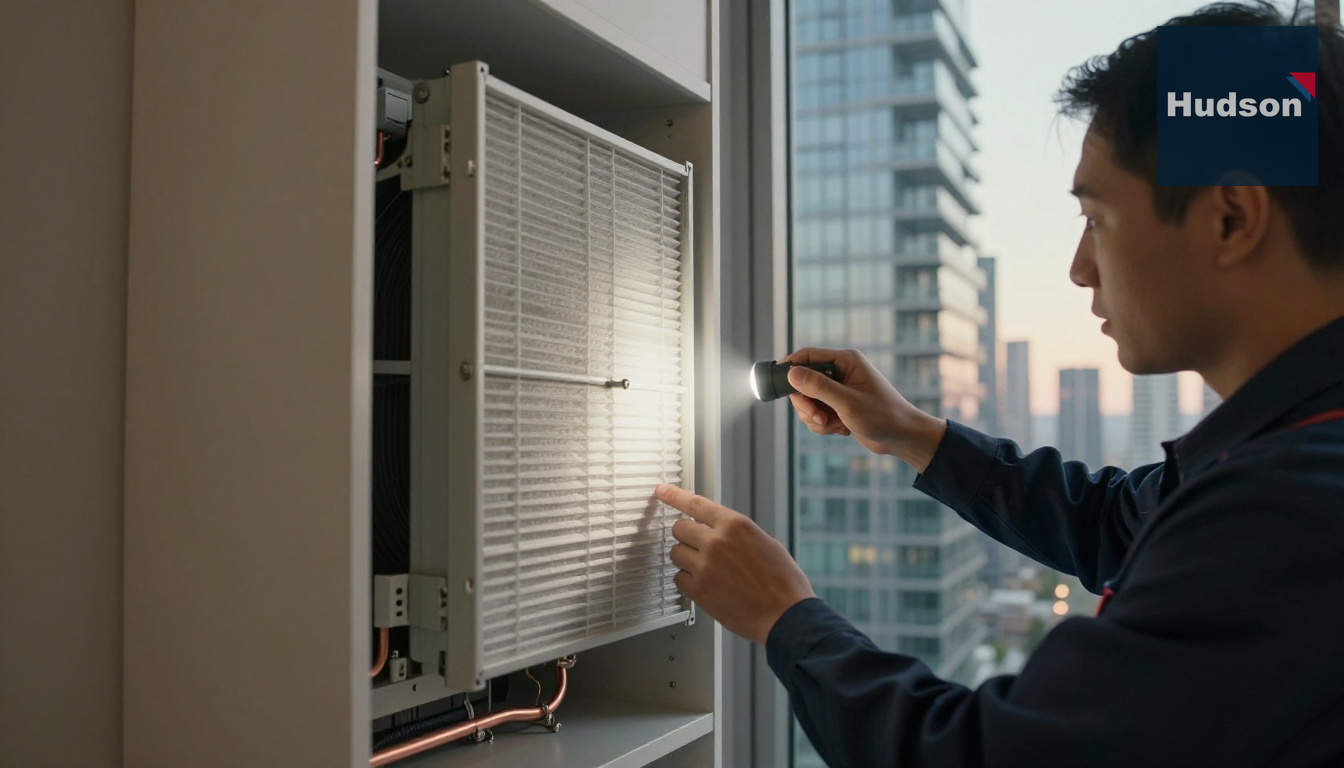
A dirty filter is still the most common preventable issue, but the important detail is that condo filters are often smaller and easier to forget than house furnace filters. In many Toronto fan coil closets, the filter is a 1-inch or 2-inch pleated filter behind the lower access panel or return grille. Common sizes include 12x20x1, 14x20x1, and 16x20x1, though Hudson sees plenty of odd sizes in custom cabinets.
Do this:
- Turn the thermostat to off.
- Open the accessible panel or grille.
- Slide the filter out and hold it up to a light.
- If you can barely see light through it, replace it.
- Make sure the airflow arrow points toward the unit, not toward the room.
A filter that is only partially blocked can still cut airflow by 20-40%. That matters because low airflow makes heating feel weak, increases blower strain, and can cause the coil to run hotter or colder than intended. If your unit hasn’t had a proper cleaning in over a year, a filter change alone may not solve the issue because the blower wheel and coil may already be loaded with dust. That’s when fan coil maintenance becomes more effective than repeated DIY filter swaps.
2. Confirm thermostat mode, schedule, and batteries
This sounds basic, but in condo service, it’s not basic at all. Hudson regularly finds thermostats left in auto, cool, or a programmed setback schedule from spring. A suite can feel “broken” simply because the thermostat is trying to maintain 19°C at night and the resident expects 23°C.
Check for these specifics:
- Mode is set to heat or auto as appropriate for your building.
- Setpoint is at least 2-3°C above room temperature for testing.
- Fan setting is correct; some fan coil thermostats allow low/med/high manual fan.
- Batteries are fresh if the model uses them.
- Screen is not dim, flickering, or blank.
A useful field clue: if the thermostat clicks but nothing happens, the issue may be downstream. If the display fades in and out, low batteries or a failing thermostat is more likely. Condo thermostats are often more specialized than homeowners realize, so if yours controls fan speeds, valve calls, or a heat pump reversing sequence, thermostat installation and replacement is safer than guessing at wiring.
3. Reset only what is designed to be reset
Some suites have an accessible breaker in the electrical panel that feeds the fan coil or heat pump. If the breaker is tripped, you can reset it once: fully off, then on. But if it trips again, stop there.
Repeated tripping usually points to something more serious than a nuisance event, such as:
- blower motor winding issues
- a failing capacitor
- water contacting electrical components
- shorted thermostat wiring
- seized bearings causing high amp draw
In our experience servicing Toronto condos, a breaker that trips twice in one evening is rarely solved by a third reset. It usually means the motor is pulling excessive current under load. At that point, blower motor repair or an electrical diagnostic is the correct next step.
4. Clear airflow restrictions around the unit
Condo closets get used for storage. Understandably. But fan coils need return air, and many units are starved because luggage, vacuum boxes, or shelving are blocking the intake path.
What to do:
- Keep at least 6-12 inches of clearance around the return air opening.
- Remove any fabric, cardboard, or plastic bins touching the unit cabinet.
- Vacuum dust from the return grille face.
- Make sure supply grilles in the suite are open and not covered by rugs or furniture.
One non-obvious issue in newer Toronto condos: decorative aftermarket grille covers can reduce free area enough to create noise and poor airflow. Hudson has measured noticeable static pressure increases in suites where residents installed “designer” vent covers that looked better but restricted the system.
5. Check for a full drain pan or slow condensate drain
Even in fall, drain problems matter because fan coils can still produce condensation during shoulder-season cooling days, and standing water from summer may still be present. If you see musty odour, light staining under the unit, or dampness near the cabinet base, inspect the accessible drain pan area if visible.
Safe DIY steps:
- Look for obvious standing water.
- Wipe the accessible area dry.
- Confirm the unit is level and not tilted forward.
- Do not pour harsh chemicals into hidden drain lines.
A little water residue can turn into microbial growth quickly in a closed condo closet. If there is visible slime, recurring overflow, or staining on adjacent drywall, book drain pan cleaning and repair before winter. Hudson also sees mold growth start in neglected pans and then spread odour through the suite, which is when HVAC mold remediation may be needed.
6. Test whether the problem is airflow, heat source, or control
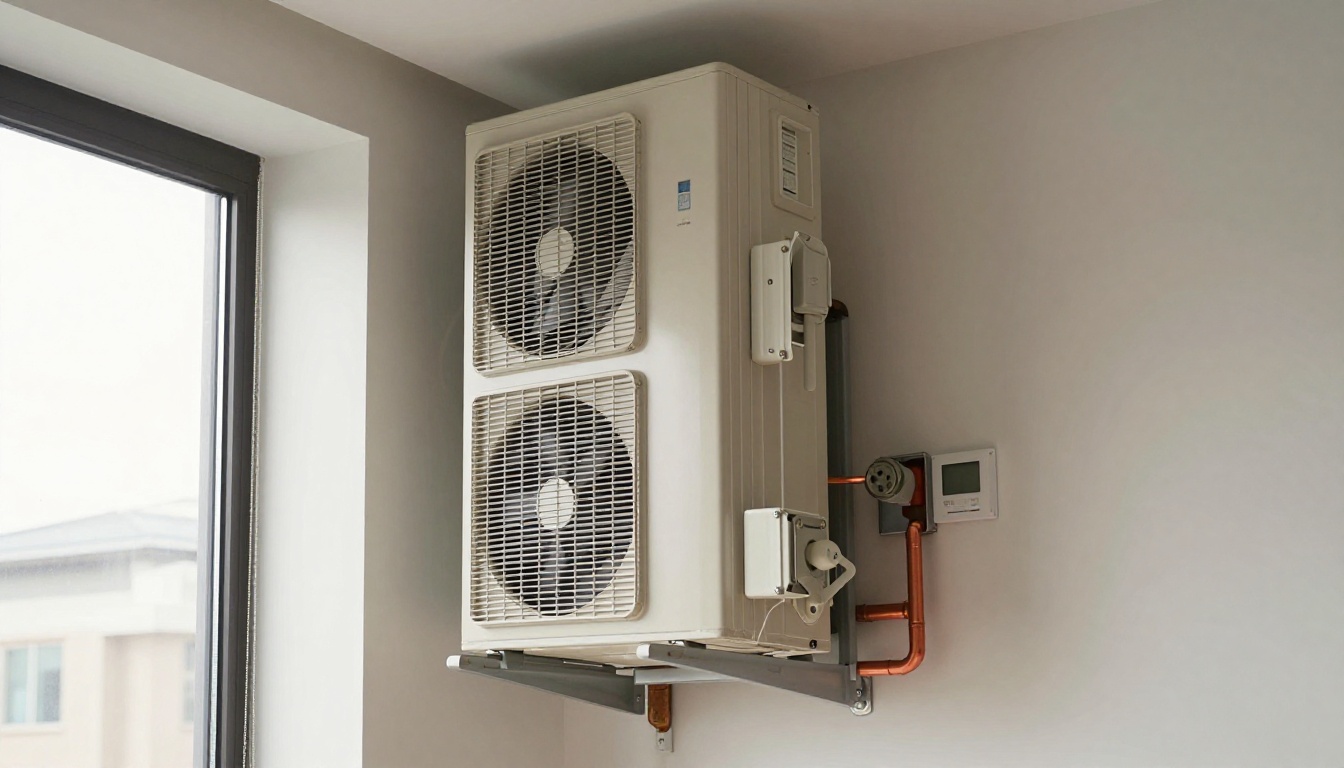
A simple test can tell you a lot without tools. Set the thermostat 3-4°C above room temperature and wait 3-5 minutes.
Then check:
- No fan, no sound: likely power, thermostat, relay, or control issue.
- Fan runs, air cool or lukewarm: likely actuator, valve, building hot-water issue, or changeover problem.
- Fan starts then stops quickly: possible safety issue, overheating motor, or control board problem.
- Strong heat for a minute then weak airflow: filter, blower wheel fouling, or motor/capacitor issue.
This kind of symptom separation helps you describe the issue accurately when booking emergency HVAC repair, which can shorten diagnosis time on site.
7. Clean the dryer vent if your suite has one
This is not part of the fan coil itself, but it is one of the most overlooked fall HVAC tasks in condos. In-suite laundry closets trap heat, lint, and fine dust, and that debris often migrates into return air pathways. In stacked laundry closets, Hudson has found dryer lint coating nearby intake grilles and blower compartments, especially in compact downtown and North York layouts where the HVAC closet is adjacent to laundry.
If your condo allows resident-level maintenance and the connection is accessible, clean the lint trap every load and inspect the short accessible vent section for buildup. For anything beyond the immediate access point, or where the run is long or hidden, schedule dryer vent cleaning. In condo buildings, restricted dryer exhaust can raise humidity, increase drying time, and contribute to dust loading around HVAC equipment.
What causes condo HVAC problems in fall, specifically?
Fall is not just “pre-winter.” It has its own failure pattern. In Toronto, October and November are when dormant issues show up because systems are changing operating mode after months of lighter use.
Actuators that sat all summer suddenly fail
A very common condo heating problem is a failed zone valve actuator. On hydronic fan coil systems, the thermostat calls for heat and the actuator opens the valve so hot water can pass through the coil. When these actuators age, they often make a clicking sound every 10-15 seconds or hum without fully opening.
In older high-rises in North York and Mississauga, Hudson frequently encounters Honeywell, Belimo, and Erie-style actuators that test fine electrically but fail mechanically under load. That means residents still hear the system “trying,” which leads them to assume the blower is the problem. If your unit has airflow but no real heat, actuator replacement is one of the first items to investigate.
3-way valves start leaking or sticking during changeover
The 3-way valve directs water flow through or around the coil. In buildings with older brass bodies and mineral-heavy loop water, internal wear can cause bypass issues, leakage, or incomplete diversion. A classic sign is a suite that overheats or never fully responds to thermostat changes.
This is one of those failures condo owners almost never spot themselves because the symptoms feel random. But from a service standpoint, it’s predictable: older building, fall startup, inconsistent heating, and a valve body that no longer seats properly. That’s where 3-way valve replacement becomes the permanent fix rather than repeated thermostat adjustments.
Blower motors reveal weakness in colder weather
A blower motor with worn bearings may run all summer at lower demand and then become noisy or unreliable once heating season starts. Listen carefully to the type of noise:
- High-pitched whine: often bearing wear
- Metal scraping: blower wheel contact or severe motor deterioration
- Buzz then no start: capacitor or motor start failure
- Rattle on startup only: loose mount, panel, or wheel imbalance
In our experience servicing Toronto condos, many “sudden” November breakdowns were actually motors giving warning signs since August. If your unit is making noise now, don’t wait for the first sub-zero weekend.
Building-level issues get mistaken for suite issues
This is especially common in larger condo communities in Toronto and Mississauga. Residents call for no heat, but the root cause is actually:
- low boiler supply temperature
- a riser balancing issue
- air trapped in a vertical stack
- failing circulation pump performance
- delayed building automation sequence after changeover
That’s why Hudson works on both in-suite systems and comprehensive mechanical maintenance. Condo HVAC troubleshooting is much faster when the technician understands both the unit and the building loop behind it.
The red lines: when DIY stops and a pro should take over
Here’s the practical rule: if the next step involves electrical testing, opening a sealed cabinet, removing a valve, touching hydronic piping, or diagnosing building-side flow, it is no longer a DIY task.
Call a professional if you notice any of the following:
- Water leaking from the cabinet or onto flooring
- Burning smell, scorched dust smell that does not clear, or melted-plastic odour
- Breaker trips more than once
- Fan runs but there is no heat after confirmed building changeover
- Repetitive clicking from the actuator area
- Thermostat is blank or erratic after battery replacement
- Airflow is weak even with a new filter
- Unit is over 15-20 years old and has recurring fall issues
For condo owners in Toronto, North York, and Mississauga, the other reason to call early is access coordination. Many buildings require elevator booking, management notice, or proof of contractor insurance. What looks like a same-day repair in a house can become a 2- to 5-day scheduling process in a condo if you wait until the problem is urgent.
What a professional condo HVAC visit actually looks like
A good service call should be more than “swap a part and leave.” In a condo, the technician needs to separate suite-level issues from building-level ones efficiently.
A typical Hudson diagnostic visit for a no-heat condo call in fall includes:
- Confirming thermostat call and control voltage or switching signal
- Checking power, breaker status, and accessible electrical safety points
- Inspecting filter, blower wheel condition, and airflow
- Testing actuator operation and valve response
- Measuring supply/return air temperature split
- Checking coil piping temperature by touch and meter
- Inspecting drain pan and cabinet condition
- Determining whether the issue is in-suite or tied to central plant/changeover
Typical timeline:
- Basic diagnosis: 30-60 minutes
- Actuator replacement: 45-90 minutes
- Thermostat replacement: 45-75 minutes
- Blower motor repair/replacement: 1.5-3 hours
- 3-way valve replacement: 2-4 hours depending on isolation and access
For buildings preparing more broadly for winter, Hudson also supports heat pump maintenance, ERV maintenance, and larger condo HVAC project planning when recurring suite failures point to aging infrastructure.
Toronto condo HVAC costs: what DIY can save, and what delayed repairs usually cost
Residents often ask whether DIY troubleshooting is worth it financially. Usually yes — if it helps avoid an unnecessary dispatch for something simple. But delayed repairs often cost more than the original problem.
Here are realistic 2026 Toronto-area ranges Hudson sees for condo HVAC service:
| Service item | Typical Toronto cost | Notes |
|---|---|---|
| Diagnostic/service call | $149-$249 | Varies by time of day, location, urgency |
| Thermostat replacement | $250-$550 | Depends on model and wiring complexity |
| Actuator replacement | $350-$600 | Common fall heating repair in fan coil units |
| 3-way valve replacement | $650-$1,100 | Labour varies if water isolation is difficult |
| Blower motor repair/replacement | $500-$1,200 | Motor type and cabinet access matter |
| Drain pan cleaning/repair | $250-$700 | More if water damage or corrosion is involved |
| Annual fan coil maintenance | $180-$320 | Often cheaper than one emergency call |
| Emergency after-hours service | $250-$500+ before repair | Higher during first cold snap |
Three cost insights most competitor articles miss:
- Condo access affects labour. A repair in a tight closet with stacked laundry or built-in millwork can take 30-60 minutes longer than the same part swap in an open mechanical space.
- Part cost is not the whole job. A $120 actuator can become a $450 repair once diagnosis, travel, setup, and testing are included.
- Building coordination can add hidden delay. If a 3-way valve requires isolation and the building needs to shut a riser or confirm loop conditions, the timeline can extend even when the actual replacement is straightforward.
If your building is seeing repeat in-suite failures across multiple stacks, it may be time to look beyond repairs and evaluate fan coil retrofit, heat pump replacement projects, or even riser replacement as reserve-fund planning items.
Repair it, maintain it, or replace it? A simple condo decision framework
This is the decision matrix Hudson often uses with condo owners and boards.
| Situation | Best option | Why |
|---|---|---|
| Unit under 10 years old, first issue, otherwise clean | Repair | Usually cost-effective if cabinet and coil are in good condition |
| Unit 10-15 years old, dirty but functional | Maintenance + targeted repair | Cleaning plus one part often buys several more seasons |
| Unit 15-20+ years old with repeated actuator/motor/valve issues | Evaluate replacement | Stacked repairs can exceed replacement value quickly |
| Multiple units in building failing seasonally | Building-wide review | Often indicates systemic age or loop problems |
| Water damage, rusted drain pan, corroded cabinet | Replacement or major overhaul | Structural corrosion tends to keep progressing |
A lot of older Toronto and North York condos still operate original or near-original in-suite equipment from the late 1990s and early 2000s. Once you start seeing rust around the base, recurring valve issues, and blower noise together, you’re usually beyond “cheap fix” territory. That’s when Hudson may recommend budgeting for fan coil retrofit rather than chasing one component at a time.
Fall checklist for condo owners before the first cold snap
If you want the most practical version of this article, use this checklist in October or early November:
- Replace or inspect the fan coil filter
- Confirm your building’s heating changeover date
- Test the thermostat in heat mode for 5 minutes
- Listen for clicking, whining, or scraping noises
- Check around the cabinet for water marks or musty smell
- Clear storage away from the return air path
- Clean accessible dryer lint areas and book deeper vent service if needed
- Book annual fan coil maintenance if it has been more than 12 months
- If your suite has a heat pump, schedule heat pump maintenance before outdoor temperatures drop sharply
This is especially important in Toronto neighborhoods with older condo stock and long heating seasons. Once November cold settles in, booking windows tighten quickly.
FAQs
Can condo owners safely fix their own HVAC system?
Some condo HVAC issues are safe for owners to troubleshoot, but only at the suite level and only without opening sealed electrical or hydronic components. Safe tasks usually include replacing a dirty filter, checking thermostat settings and batteries, clearing the area around the return grille, and confirming whether the building has switched from cooling to heating. In Toronto condos, many no-heat calls in October and November turn out to be seasonal changeover confusion in 2-pipe buildings, not actual equipment failure.
Why does my condo fan coil run but not heat the suite?
If the blower runs but the air stays cool, the most common causes are a stuck actuator, a failed 3-way valve, air trapped in the hydronic coil, or a building-level issue such as low hot-water temperature from the boiler loop. In older North York and Mississauga buildings from the 80s and 90s, Hudson often finds Honeywell or Erie-style actuators clicking every 10-15 seconds without fully opening. A clogged filter can also reduce airflow enough that the unit feels ineffective even when hot water is present.
How often should a condo HVAC unit be serviced?
For most Toronto condo fan coils and in-suite heat pumps, annual service is the minimum, and twice per year is better if the unit runs year-round. Fall is the best time to inspect heating performance, flush the drain, check the blower capacitor, test the thermostat, and confirm the actuator and valve are responding before the first real cold snap. In buildings near the waterfront or high-traffic corridors, filters and blower wheels often load up faster because of fine dust and humidity.
What are the warning signs that I should call an HVAC professional right away?
Call a professional immediately if you smell burning plastic, see water leaking from the fan coil cabinet, hear metal-on-metal screeching from the blower motor, or if the breaker trips repeatedly after reset. Another urgent sign is a thermostat that calls for heat but the suite temperature keeps dropping below 18°C as outdoor temperatures fall toward freezing. In condos, a small in-suite symptom can also point to a larger riser, valve, or building-loop issue, so delays often make the eventual repair more expensive.
What does condo HVAC repair usually cost in Toronto?
Typical Toronto pricing for condo HVAC work varies by part, access, and building rules. A diagnostic visit often runs about $149-$249, a thermostat replacement is commonly $250-$550 installed, an actuator replacement is usually $350-$600, a 3-way valve replacement can range from $650-$1,100, and blower motor repairs or replacement often land between $500 and $1,200. Emergency after-hours service costs more, especially during the first major cold snap when demand spikes across Toronto, North York, and Mississauga.
Can I replace my condo thermostat myself?
Sometimes, but condo thermostats are not always simple low-voltage devices like house thermostats. Many suites use line-voltage controls, proprietary fan coil interfaces, or building-specific sequences that affect fan speed, changeover, and valve control, so incorrect wiring can damage the board or leave the unit heating continuously. If you remove the cover and see more than basic R, W, Y, G, and C terminals, or if the thermostat controls a fan coil or heat pump with multiple modes, it is usually smarter to book professional thermostat service.
Next steps for condo owners in Toronto
If your condo HVAC system has been noisy, inconsistent, or untouched since last winter, fall is the time to deal with it — not the first freezing weekend in late November. The safest DIY approach is to handle the simple checks yourself, document the symptoms clearly, and call for help before a minor actuator, thermostat, or drain issue becomes a no-heat emergency.
Hudson specializes in condominiums, not detached-house HVAC guesswork. That matters because condos involve shared loops, building access rules, risers, fan coils, heat pumps, ERVs, and the real-world coordination that comes with Toronto towers. If your system hasn’t had service in over a year, book a maintenance visit now. If it has already stopped heating, request a diagnostic before the building-wide rush.
For more condo-specific guidance, visit the Hudson HVAC blog or book service with Hudson.
Contact Hudson
- Contact Us
- Phone: +1 (437) 448-0640
- Email: service@hudsonhvac.ca