
Heat Pump Rebate Quotes: A Homeowner’s Comparison Worksheet
Compare heat pump quotes before counting on a rebate. Use Hudson’s worksheet to check equipment, installation scope, payment timing and rebate assumptions.
- Hudson HVAC
- 10 min read

Information checked October 14, 2026.
Compare the full installation price and scope before subtracting any heat pump rebate. Then check the proposed equipment, who is responsible for the application, and what you must pay before any rebate arrives. That order makes it much easier to compare two offers fairly while Canada’s new National Heat Pump Rebate Program is being developed.
The headline incentive is only one part of the decision. A lower advertised “after-rebate” price can leave you comparing different equipment, different amounts of installation work, or different funding assumptions. This guide gives you a practical worksheet to turn those offers into a clear decision. You can use it with a Hudson proposal or another contractor’s quote.
For the broader signup steps, start with Canada’s new heat pump rebate: how to sign up and get ready. Here, the focus is the written proposal in front of you: what it includes, what remains uncertain, and what needs answering before you accept it.
The program status matters when reading a quote
The federal backgrounder announces a $2 billion National Heat Pump Rebate Program, with up to $10,000 for below-median-income households and $2,000 for other eligible homeowners. It describes eligible cold-climate air-source equipment and a process involving approval before purchase and installation. These are announced terms, not a personal approval.
As checked today, the official federal campaign page still describes the rebate as upcoming and offers updates about launch dates, eligibility and applications. Do not treat a contractor’s quote or interest-list signup as an application to that program.
Ontario’s existing Home Renovation Savings program has a separate process. Its heat pump instructions require a participating contractor and approval of a pre-installation application before installation. A quote should name the program it relies on rather than simply say “government rebate.”
Start by asking for three separate figures
Ask every contractor to separate these figures clearly:
- Complete project price: the equipment and agreed installation work, with taxes and exclusions identified.
- Amounts payable and their due dates: deposit, progress payments and final balance, including whether a lender is involved.
- Potential incentive: the exact program, assumed amount, conditions and current approval status.
The third figure should not obscure the first two. Even an approved incentive does not necessarily reduce the amount due to the installer on installation day. Ask who receives the rebate, whether the quote assumes an assignment or credit, and how that arrangement is documented.
If financing is proposed, request the borrowing terms separately from the installation price. Record the payment amount, term, interest rate, fees and total repayment shown in the lender’s documents. A monthly payment alone does not tell you the complete project cost.
Copy this worksheet for each proposal
Create one copy for each contractor, using the same headings. Mark every item included, excluded, or not yet confirmed. An empty box is an unanswered question, not an included item.
| Record on each quote | What to write down | Follow-up if missing |
|---|---|---|
| Quote reference | Contractor, date, version and expiry | How long are the price and equipment availability valid? |
| Proposed system | Indoor and outdoor models, associated furnace or air handler, and AHRI reference where applicable | Which exact combination will be supplied? |
| Existing equipment | What stays, what is removed, and disposal arrangements | Does the price assume reusing any equipment? |
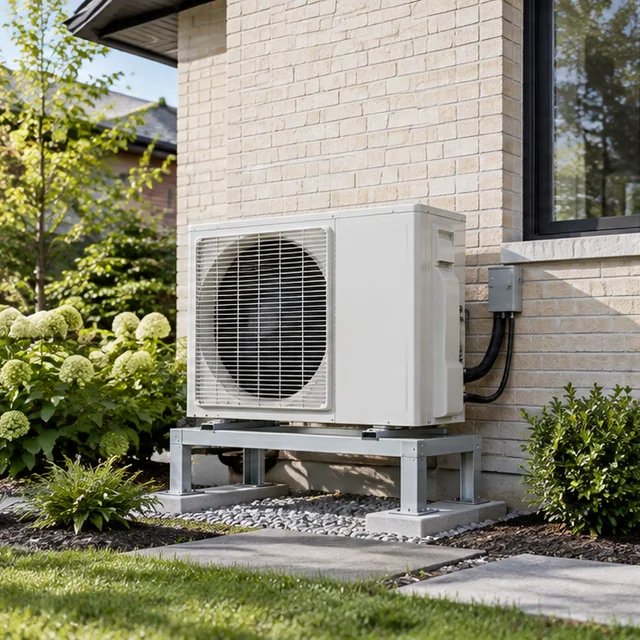
| Installation scope | Electrical, ductwork, refrigerant lines, drainage, supports, controls and finishing | Which work is excluded or still subject to a site check? |
| Home requirements | Sizing approach, rooms served and backup-heating plan | What information about my home supports this design? |
| Project total | Price before incentives, taxes, allowances and optional items | What could change the final invoice? |
| Payment schedule | Deposit, later amounts, due dates and payee | What is due before any rebate payment? |
| Rebate assumption | Program name, amount, evidence and status | Is this an estimate or an approval for this project? |
| Application owner | Person responsible for each submission and next action | What must I do myself, and by when? |
| Completion package | Startup records, model/serial information, invoice and warranties | What will I receive at handover? |
Keep revisions together. If a contractor changes the model or adds electrical work, ask for an updated written proposal rather than trying to reconcile a phone conversation with an older price sheet.
Check the system behind the brand name
A brand and a nominal size are not enough to identify a proposed installation. Ask for the outdoor unit, indoor equipment, and any retained furnace or air handler to be listed together. The equipment reference should make it possible to check the actual combination, not a similar product from the same manufacturer.
NRCan’s homeowner guidance recommends discussing model and AHRI details, proper sizing, unit placement and warranties with the contractor. An AHRI reference is useful identification information; it is not, by itself, approval for the new federal rebate.
Ask the contractor to identify the specific program list and rule used for any eligibility claim. Equipment appearing on a list for another incentive does not establish that your planned installation meets the new program’s requirements.
If two quotes recommend different sizes
Avoid choosing between them by assuming the larger unit is better. Ask both contractors:
- What heating and cooling requirements did you calculate for this home?
- What performance information supports the recommendation in local winter conditions?
- Which rooms will this system serve, and how will heat reach them?
- What existing or new equipment provides backup heat, and how will the controls manage it?
- Have planned insulation, window or other home upgrades been considered?
NRCan explains that sizing should account for the home’s loads, climate and installation objectives in its heating and cooling guide. Ask for the design explanation in language you can use to compare the proposals. You do not need to become an equipment designer to recognize an unanswered question.
Turn exclusions into questions before signing
“Standard installation” is difficult to compare unless the proposal explains what standard includes. Use your home’s actual conditions to turn that phrase into a written scope.
For example, if one contractor has inspected the electrical panel and another has not, their prices may be based on different assumptions. Ask whether electrical work is included, an allowance, or a separate quotation. Apply the same approach to duct changes, access restrictions and removal of existing equipment.
For each unresolved item, record four things: what needs checking, who checks it, when it will be checked, and how any price change is approved. This makes the uncertainty visible without assuming that every home needs extra work.
Also ask who coordinates any permits, inspections or property approvals that apply to your project. For a condominium or a home with shared exterior space, confirm permissions with the relevant property authority before treating an equipment location as settled. An installer’s proposal and permission to use shared space are separate records.
Use a decision test, not just the lowest net price
The following examples are hypothetical comparisons, not Hudson prices or customer projects.
| What the proposals show | Why they are not yet comparable | Useful next step |
|---|---|---|
| Quote A shows a complete installed total; Quote B shows only a price after an estimated rebate | The amount payable before incentives is unclear on B | Request B’s full price and payment schedule |
| A includes a site-confirmed electrical scope; B says “electrical extra if required” | One proposal has a defined scope; the other has an unresolved item | Ask B for a site check and a written allowance or price |
| A identifies all equipment; B lists only a brand and tonnage | You cannot compare the exact systems or verify the stated eligibility basis | Request model details and the relevant product-list reference |
| A names an application owner; B says “rebate handled” | Responsibility for submissions and follow-up is unclear | List each submission, responsible person and required evidence |
A proposal is ready for a meaningful comparison when you can answer three questions:
- What system and work am I buying?
- What am I obligated to pay, and when?
- Which rebate claims have evidence, and which remain assumptions?
If one answer is missing, ask for clarification before ranking that offer against a complete one.
Keep provincial and federal amounts on separate lines
The Prime Minister’s announcement states that the new federal rebate can be combined with existing provincial programs. That announced intent should not be read as a confirmed combined amount for your home.
A quote should still identify each incentive separately and show the eligibility, equipment and timing assumptions for each. Ask for the applicable rules before adding the amounts together. If one incentive is not approved, keep it labelled as an estimate rather than treating it as part of your available payment funds.
For the program-by-program comparison, read federal vs. Ontario heat pump rebates. That guide covers the different routes; this worksheet helps you see how a contractor has applied those assumptions to a particular proposal.
A short message you can send with your quote questions
Please send the complete installed price before incentives, with taxes, exclusions and payment dates shown separately. Please also confirm the exact equipment combination, the basis for sizing it for my home, and the program name and evidence behind each rebate estimate. For any work or eligibility detail still unconfirmed, please identify the next step and who is responsible.
Save the reply with the dated quote. Before approving a later equipment substitution or scope change, ask whether the change also affects the proposed incentive, installation approvals or payment schedule.
How Hudson can help you prepare
Hudson offers home heat pump installation, service and rebate guidance in Toronto and the GTA. When you contact our team, share your postal code, current heating type, project timeline and any comfort concerns. Those details help start a useful conversation about your installation rather than only the rebate headline.
You can also join Hudson’s Heat Pump Rebate Interest List for program updates and help planning your next steps. Hudson is an independent service provider. The list is not a government application, an eligibility decision or a reservation of funding, and program administrators determine approval and payment.
Use the worksheet to ask clear questions now, while keeping the final funding decision tied to official instructions and your own approval record.
Common questions
Can I compare heat pump quotes before the new federal rebate opens?
Yes. Compare the complete installation scope and price before incentives now. Keep federal rebate assumptions separate and confirm the final application and installation rules before relying on funding. A quote does not establish eligibility.
Should the quote show a price before rebates?
Ask for the full project total, taxes, exclusions and payment schedule before incentives. Show each proposed rebate separately with its program name and approval status, so an estimated net price does not hide what you may need to pay upfront.
What if two contractors recommend different heat pump sizes?
Ask each contractor for the home heating and cooling requirements used, the proposed equipment performance, and the backup-heating plan. Different sizes need an explanation based on your home and the intended installation, not just a comparison of nominal tonnage.
Does an AHRI number prove eligibility for the new rebate?
No. It helps identify the proposed equipment combination. Eligibility must be checked against the specific program’s required product list and installation rules; qualification under another program is not automatic proof.
How do I sign up with Hudson while comparing quotes?
Join Hudson’s Heat Pump Rebate Interest List with your contact details, postal code and existing heating type, or contact Hudson about installation planning. The interest list provides updates and guidance; it is not a government application or a funding reservation.