
Toronto Condo Chiller Guide: Repair, Maintenance & Costs
Learn how a condo chiller works in a Toronto condo, common faults, repair costs, and maintenance tips for chilled water loop systems.
- Hudson HVAC
- 13 min read
Toronto Condo Chiller Guide: Repair, Maintenance & Costs
Quick summary: A chiller is the central machine that makes cold water for many Toronto condo buildings. If it fails, this is not a one-suite problem—cooling can disappear for an entire tower, which is why proper chiller maintenance and fast diagnosis matter so much.
Most condo residents never see the chiller, but they feel the effects immediately when it is not working. At Hudson HVAC, we regularly troubleshoot in-suite comfort complaints that trace back not to the fan coil, thermostat, or valve in the suite, but to the building’s chilled water loop and central plant.
What Is a Chiller?
A chiller is the central machine that removes heat from a building’s water loop so that suites can be cooled. In plain English, it is the building’s cold-water factory. Instead of each condo having its own outdoor air conditioner, most Toronto high-rise condos use one or more chillers to produce chilled water, which is then pumped throughout the building.
That chilled water travels to in-suite equipment like fan coils and some water-source heat pump systems. Inside the suite, your unit blows air across a cold coil, and that is what cools the room. If you want to understand the in-suite side of that system, Hudson has separate guides on fan coil repair, heat pump repair, and thermostat replacement.
A simple analogy: think of the chiller as the building’s central refrigerator. Your suite equipment is like the small fan that moves air over the cold surface. If the refrigerator stops making things cold, the fan can still run—but you will only get room-temperature air.
In most Toronto condos, the chiller is found in a mechanical room, service floor, or rooftop/penthouse plant, not inside a suite. That is an important point because residents often assume a cooling problem must be in their condo unit. In our experience, when several suites call in at once from different floors in Toronto, North York, or Mississauga, the central chilled water system is one of the first things we ask management to check.
One non-obvious detail: some buildings have a seasonal switchover policy or a limited chilled water operating schedule in spring and fall. So a resident can have a perfectly healthy fan coil and still feel warm because the building has not enabled full cooling yet.
What Does It Look Like?
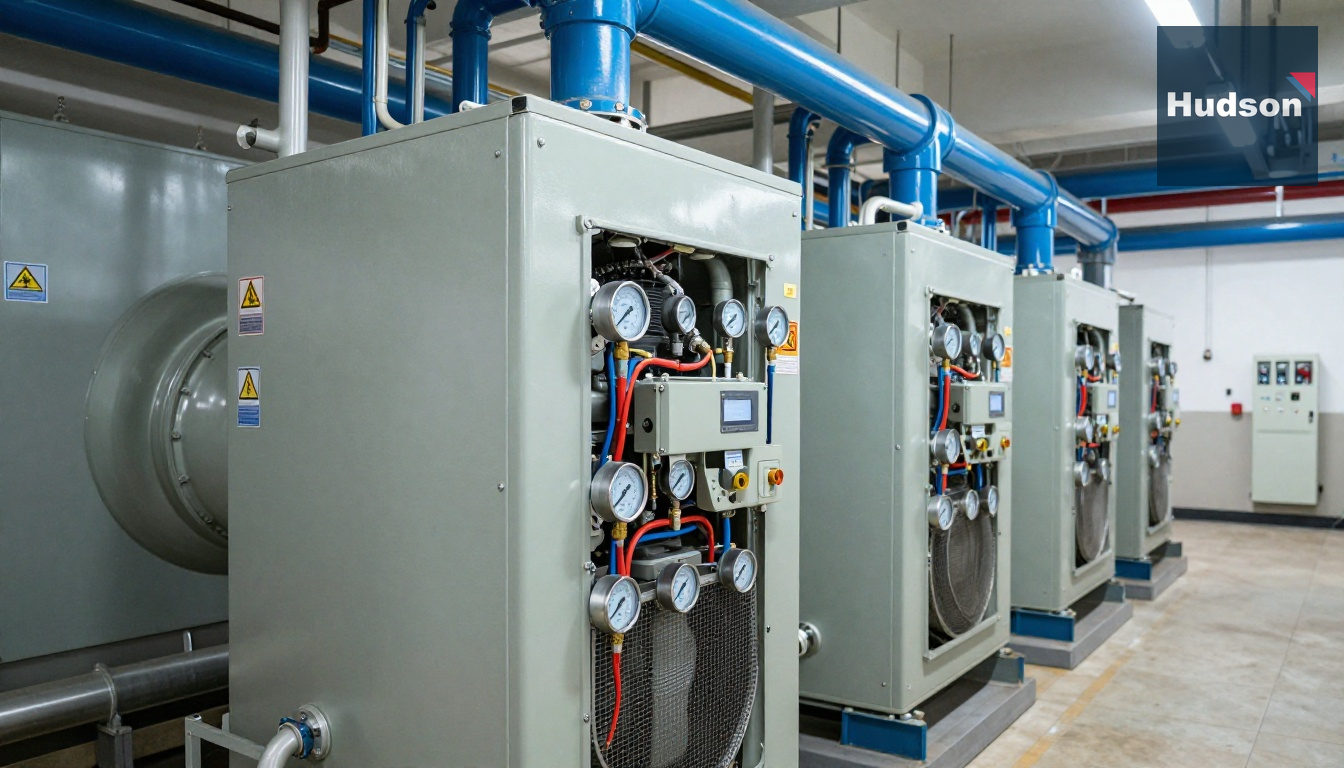
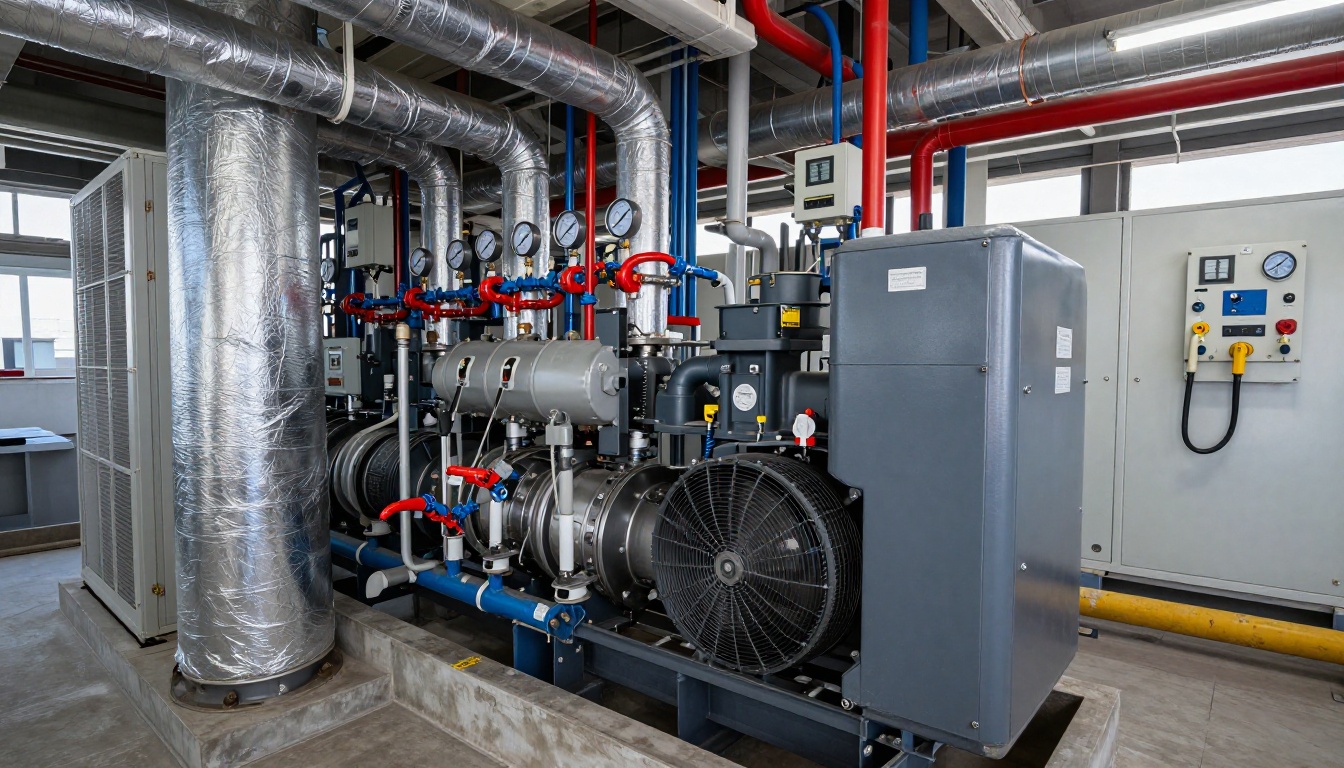
A condo chiller is a large commercial machine—far bigger than anything inside your suite. Depending on the building, it may be a long rectangular unit with large insulated pipes, valves, gauges, electrical panels, and sometimes a touchscreen controller on the front. Some are air-cooled, but in many Toronto condos the central plant uses water-cooled chillers tied into a condenser water system and cooling tower.
Common visual features include:
- Large supply and return pipes with insulation
- Butterfly or isolation valves on the chilled water connections
- Pressure and temperature gauges
- A compressor section inside the cabinet
- Control wiring, sensors, and safeties
- In many newer systems, a VFD (variable frequency drive) or digital controller
If you were standing in front of one, you would not mistake it for a suite-level HVAC component. A fan coil blower motor fits in a closet cabinet; a chiller can take up a big section of a mechanical room.
Common Brands and Models
In Toronto condo mechanical rooms, some of the brands and model families we commonly see include:
- Carrier AquaEdge / AquaSnap chillers
- Daikin / McQuay Pathfinder and Magnitude series
- Trane RTAC / RTWF / CenTraVac families
- York YCAL / YK chillers
The exact model depends on the building age, tonnage, and whether the plant is air-cooled or water-cooled. Newer buildings may have more sophisticated controls and BACnet integration, while older towers often have legacy controls that still work but become harder to support as parts age.
A useful field insight: the model number matters less to residents than the plant design around it. We have seen buildings with a perfectly good chiller still struggle because of dirty strainers, failed pumps, bad actuator control on related hydronic equipment, or poor water balancing. That is why Hudson looks at the full system, not just the machine itself. For related hydronic control issues, see actuator replacement and 3-way valve replacement.
How Does It Work?
At a basic level, the chiller takes heat out of the building’s chilled water loop and rejects that heat somewhere else. In a water-cooled system, that heat is often sent to condenser water and then to a cooling tower. In an air-cooled system, fans move outdoor air across the condenser section.
Here is the simple version of the cycle:
- Warm return water comes back from the building’s suites and common areas.
- The chiller cools that water down—often to around 42°F to 45°F leaving water temperature, depending on design and operating conditions.
- Pumps send that chilled water back through the building.
- In each suite, a fan coil or heat pump coil absorbs heat from the indoor air.
- The water warms up again and returns to the chiller to repeat the cycle.
Inside the machine, refrigerant does the actual heat transfer work. The compressor raises refrigerant pressure, the condenser rejects heat, the expansion device drops pressure, and the evaporator absorbs heat from the chilled water. Residents do not need to memorize that cycle, but it explains why a refrigerant issue, flow issue, or controls problem can shut the entire cooling chain down.
One thing many non-experts do not realize: the chiller can be “running” and still not be delivering useful cooling. We have seen central plants where the machine is enabled, but the leaving chilled water temperature is too high because of low refrigerant charge, fouled heat exchanger surfaces, condenser issues, sensor drift, or inadequate water flow. To a resident, that feels like weak cooling. To a technician, that is a very different problem than a total no-start.
Another key point for Toronto condos: shoulder seasons matter. In fall, some buildings still need cooling on sun-exposed west-facing suites, server rooms, or amenity spaces even when outdoor temperatures are lower. This is why preventive planning through mechanical maintenance is so important before winter and before next cooling season.
If your suite is not comfortable, Hudson may also inspect in-suite components like the blower motor, thermostat, or the fan coil itself through fan coil maintenance. But if many suites are affected, we start thinking bigger.
Signs It Might Be Failing
When a condo chiller is having problems, the symptoms often show up across multiple suites or in building-wide comfort patterns rather than one isolated room.
Here are the most common warning signs we see:
- Multiple residents report no cooling at the same time. This is one of the biggest clues that the issue is central, not inside a single suite.
- Fan coils are blowing air, but it is not cold. The in-suite unit may sound normal, yet the air temperature barely drops.
- The building loop temperature is too warm. Residents will not measure this directly, but building staff may notice poor delta-T or elevated supply water temperatures.
- Intermittent cooling during hot afternoons. A chiller can struggle under load before failing completely, especially if condenser tubes are fouled or sensors are inaccurate.
- Frequent alarms or resets in the mechanical room. Common examples include low chilled water temperature safeties, flow faults, high head pressure, freeze protection trips, or communication/control faults.
- Sudden comfort complaints after seasonal changeover. Sometimes the machine itself is fine, but the building has not transitioned controls, pumps, or valves correctly.
A telltale sign that many condo residents miss is this: if your suite cools a little overnight but not during the afternoon, that often points to a capacity problem rather than a complete shutdown. We have seen this with dirty condenser tubes, restricted flow, and weak staging on multi-compressor systems.
Another subtle clue is when lower floors report different symptoms than upper floors. That can indicate loop balancing, pump performance, or control valve issues—not just the chiller itself. This is why central plant diagnosis should be coordinated with suite-level checks and, where needed, heat pump maintenance or fan coil maintenance.
Can You Test It Yourself?
If you are a condo resident, there is very little you should physically test on the chiller itself, because it is building equipment in a restricted mechanical area. However, there are a few safe checks you can do before calling management or Hudson.
Safe DIY checks:
- Check whether the fan in your suite unit is running. If air is blowing but not cooling, that helps narrow the issue.
- Set the thermostat several degrees lower and wait 10-15 minutes. If there is no change, note that when reporting the issue. Hudson can help with thermostat issues.
- Ask a neighbour on another floor if they are having the same problem. That is often the fastest way to tell whether the issue is building-wide.
- Check for building notices about seasonal changeover, chilled water shutdowns, or central plant maintenance.
- Look for water leaks around your in-suite unit. A leak does not prove a chiller problem, but it can point to a separate issue needing drain pan cleaning or repair.
What not to do:
- Do not enter the mechanical room unless authorized.
- Do not touch valves, pumps, electrical disconnects, or control panels.
- Do not attempt to reset commercial equipment.
- Do not remove access panels from in-suite equipment if you are not comfortable around line voltage and moving parts.
For property managers or superintendents, the first practical checks are usually trend logs, alarm history, pump status, entering/leaving water temperatures, and whether the BAS is actually calling for cooling. In our experience, one of the most overlooked issues is a failed sensor causing the controls to make the wrong decision even though the equipment itself is mechanically fine.
If there is an urgent building-wide loss of cooling or a related HVAC emergency, use Hudson’s emergency HVAC repair service.
When to Replace vs Repair
For a condo chiller, the replace-versus-repair decision is usually made by the property manager, board, and mechanical consultant—not an individual resident. Still, it helps to understand the logic.
Typical Lifespan and Cost
A well-maintained chiller in a Toronto condo typically lasts 20 to 30 years. We have seen some premium machines exceed that, but after about year 20, the conversation changes from “Can it be repaired?” to “How much risk are we carrying into the next cooling season?”
Typical Toronto cost ranges:
- Diagnostic/service visit: $450-$950
- Controls, sensor, relay, or contactor repair: $900-$3,500 including parts and labour
- VFD or control board related repairs: $2,500-$12,000+ depending on manufacturer and availability
- Tube cleaning / heat exchanger cleaning: $1,500-$6,000 depending on size and access
- Refrigerant leak diagnosis and repair: $2,500-$15,000+ depending on leak location and refrigerant type
- Compressor-related repairs: $8,000-$25,000+
- Full chiller replacement: often $150,000-$500,000+ for a condo building, depending on tonnage, crane requirements, controls integration, and plant modifications
Those numbers are realistic for Toronto, Vaughan, and the GTA in 2026. Costs vary a lot based on access, refrigerant, electrical scope, after-hours work, and whether the repair affects only the machine or the surrounding plant.
When Repair Makes Sense
Repair is usually worth it when:
- The machine is under about 15-20 years old
- The failure is in controls, sensors, safeties, or replaceable electrical components
- The compressor and heat exchangers are still in good condition
- Parts are available in a reasonable timeframe
- The building has redundancy from a second chiller
When Replacement Starts Making More Sense
Replacement becomes more likely when:
- The chiller is 20+ years old and has recurring major faults
- The refrigerant is obsolete or expensive to source
- The compressor has failed and the machine has a history of other issues
- Controls are no longer supported by the manufacturer
- Energy use is high compared with modern equipment
- The board wants to avoid a mid-summer tower-wide outage
A practical field insight: many boards wait too long because the chiller “still runs.” But if it needs frequent resets, has unreliable controls, or cannot maintain temperature on hot days, that is already a warning sign. Planned replacement is almost always less disruptive and less expensive than emergency replacement after a full breakdown.
How Hudson Handles This Repair
Hudson works on condo HVAC systems every day, but with chillers, the process is slightly different because this is central mechanical equipment affecting the whole building.
Our approach usually looks like this:
- Confirm the complaint pattern. Is this one suite, one stack, or the whole building?
- Check in-suite operation where needed. We confirm whether fan coils, thermostats, and valves are responding normally using our fan coil repair and heat pump repair workflow.
- Review central plant conditions. We look at chilled water temperatures, pump operation, valve positions, BAS trends, and alarm history.
- Pinpoint the failure mode. That could be a control issue, flow issue, fouled heat exchanger, refrigerant problem, sensor drift, or staging problem.
- Recommend the right level of action. Sometimes that is a same-day repair. Sometimes it is a temporary operating strategy plus a planned capital recommendation.
- Coordinate with building management. Since a chiller affects all residents, communication matters almost as much as the repair itself.
In our experience, the fastest wins often come from the “boring” faults: failed sensors, tripped safeties, bad relays, stuck valves, dirty strainers, or pump interlock problems. Those issues are less dramatic than a failed compressor, but they cause a surprising percentage of no-cooling complaints.
For buildings preparing for winter, Hudson also helps management use the off-season wisely. Fall is a smart time to schedule central plant reviews, deferred repairs, and preventive work through our mechanical services page rather than waiting for the first heat wave next year.
FAQs
Is the chiller inside my condo unit?
No. In almost all Toronto high-rise condos, the chiller is a central building machine located in the mechanical room, penthouse plant, or on a service level—not inside your suite. Your in-suite fan coil or water-source heat pump depends on the building’s chilled water loop, so if the chiller is down, many or all suites can lose cooling at the same time.
How long does a condo chiller usually last?
A well-maintained condo chiller typically lasts 20-30 years, and some premium machines make it past 30 with proper water treatment, annual inspections, and timely control upgrades. In our experience, the compressor may need major work earlier if the building has chronic flow issues, dirty condenser tubes, poor glycol chemistry, or repeated low-temperature trips.
What does chiller repair cost in Toronto?
It depends on the fault. A basic service call and diagnostic in Toronto often runs $450-$950, while control repairs, sensor replacement, or contactor work may land in the $900-$3,500 range. Larger repairs—such as VFD issues, tube cleaning, refrigerant leak repair, or compressor-related work—can range from $5,000 to $25,000+, and a full chiller replacement can be $150,000 to $500,000+ depending on tonnage and plant design.
Why would my suite be warm if my fan coil seems to be working?
If the fan is running but the air is not cool, the issue may be upstream in the building’s chilled water system rather than inside your suite. We often see this when the chiller is off, the chilled water loop is too warm, pumps are not circulating properly, or the building is in seasonal changeover. A telltale sign is when multiple residents on different floors report the same cooling complaint at the same time.
What maintenance does a condo chiller need before winter?
In fall, the focus is usually on winter preparation and off-season protection rather than active cooling. That often includes reviewing freeze protection settings, checking glycol concentration where applicable, inspecting strainers and pumps, trending sensor readings, confirming safeties, and planning tube cleaning or control repairs before next spring. For buildings with shoulder-season cooling demand, the chiller may still need to stay partially available even in cooler weather.
Call to Action
If your building has weak cooling, repeated no-cooling complaints, or a suspected condo chiller issue, do not assume the problem is only inside the suite. Hudson can help determine whether the fault is in the fan coil, thermostat, control valve, or the central chilled water loop itself.
For urgent building-wide cooling problems, book emergency HVAC repair. For preventive planning before next season, schedule a central plant review through our mechanical services team. You can also explore more condo HVAC resources on the Hudson blog.
Contact Hudson
- Contact Us
- Phone: +1 (437) 448-0640
- Email: service@hudsonhvac.ca