
Toronto Condo HVAC Guide for First-Time Buyers
A practical condo HVAC guide for first-time buyers in Toronto. Learn systems, costs, red flags, maintenance, and what to inspect before closing.
- Hudson HVAC
- 16 min read
Toronto Condo HVAC Guide for First-Time Buyers
Quick summary: Buying a condo in Toronto means buying into two HVAC systems at once: the equipment inside your suite and the larger building systems that support it. If you understand the difference between a fan coil, heat pump, ERV, riser system, and seasonal changeover before you close, you can avoid one of the most common first-year surprises in condo ownership: an expensive heating or cooling issue that was hiding in plain sight.
For first-time buyers, this guide breaks down how condo HVAC systems actually work, what to inspect before purchase, what repairs typically cost in Toronto, and what maintenance matters most as fall turns into winter. If you are comparing units in Toronto, North York, or Mississauga, this is the practical field guide Hudson HVAC wishes more buyers had before move-in day.
The part most buyers miss: you are not just buying a suite, you are buying into a mechanical ecosystem
In detached homes, the furnace and AC are usually yours alone. In condos, the reality is different. Your comfort depends partly on in-suite equipment and partly on shared building infrastructure: boilers, chillers, pumps, risers, make-up air systems, corridor pressurization, and sometimes energy management controls. That means a condo suite can have a perfectly serviceable fan coil and still underperform because the building’s hydronic loop is air-bound, the switchover is delayed, or a central plant issue is reducing water temperature.
This is why first-time buyers in Toronto should treat HVAC as both a suite-level inspection issue and a building-level due diligence issue. Hudson has serviced more than 200 condo buildings across the GTA, and one pattern shows up repeatedly: buyers focus on finishes, windows, and appliances, but skip the mechanical closet. Then in late October, when temperatures in Toronto swing from 16°C afternoons to 2°C nights, they discover their “working” system only worked during a mild shoulder season.
If you are buying in an older high-rise in North York, a waterfront tower in Toronto, or a newer mid-rise in Mississauga, it helps to understand what type of system is actually in the unit. A good starting point is knowing whether you are dealing with a fan coil, heat pump, or less commonly, electric baseboard supplemented by central ventilation. For ongoing care, in-suite HVAC maintenance is often the difference between predictable ownership costs and surprise emergency calls.
Condo HVAC systems explained: what is actually inside the closet?
Fan coil units
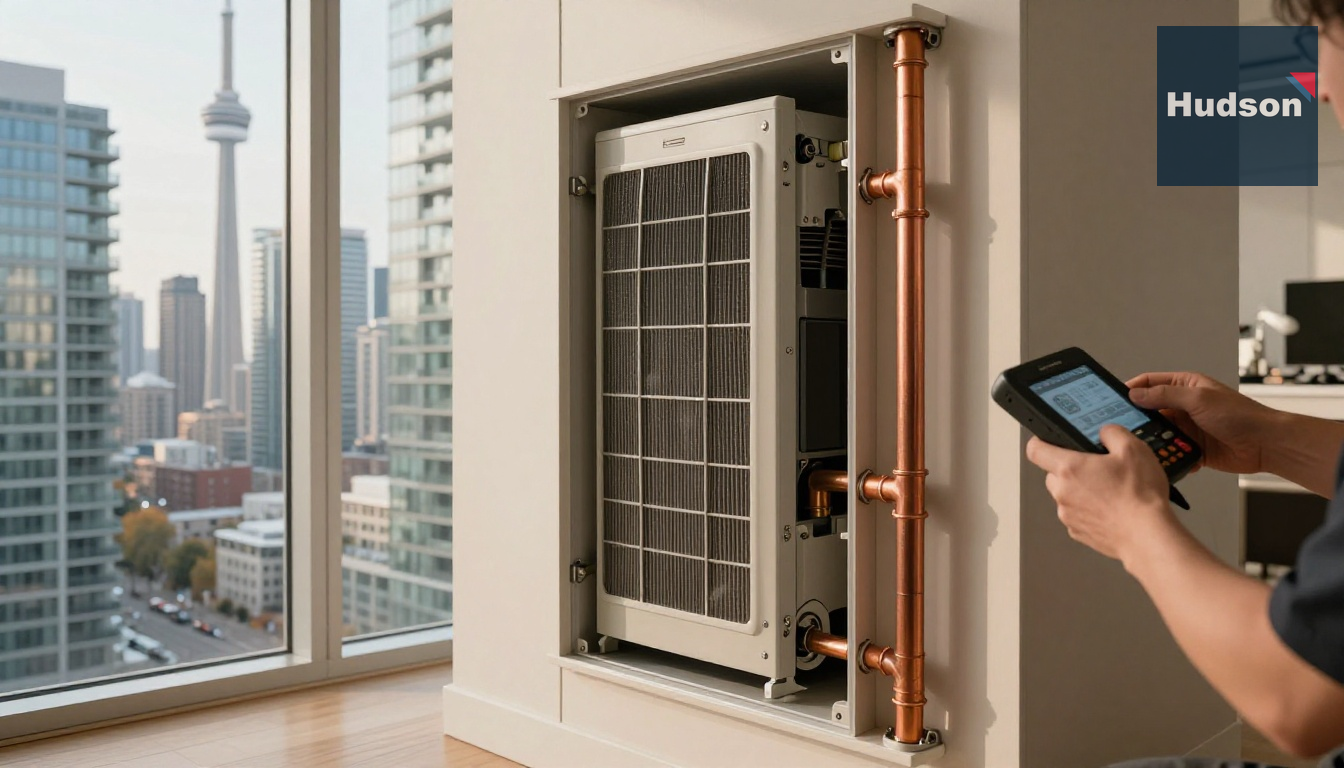
A fan coil unit is one of the most common condo HVAC systems in Toronto. It is usually a tall vertical metal cabinet in a closet near the front hall, bedroom, or laundry area. Inside, there is a blower, a coil, a filter, a drain pan, control wiring, and typically one or more valves regulating hot or chilled water flow.
In simple terms, the building sends hot or chilled water to your suite, and the fan coil blows air across the coil to heat or cool the space. In many condos built before about 2005, this is a 2-pipe system, meaning the building is in either heating mode or cooling mode, not both. That is why residents often complain during spring and fall shoulder seasons: if the building has not switched over yet, your thermostat cannot force cooling from a heating loop or vice versa.
A lot of buyers do not realize that “the AC works” during a showing in September may only mean the fan is running. If the building has already switched to heating water, no amount of thermostat adjustment will produce cold air. This is also where fan coil repair and replacement becomes a common service call, especially in older Toronto and North York towers with aging actuators and 3-way valves.
Heat pumps
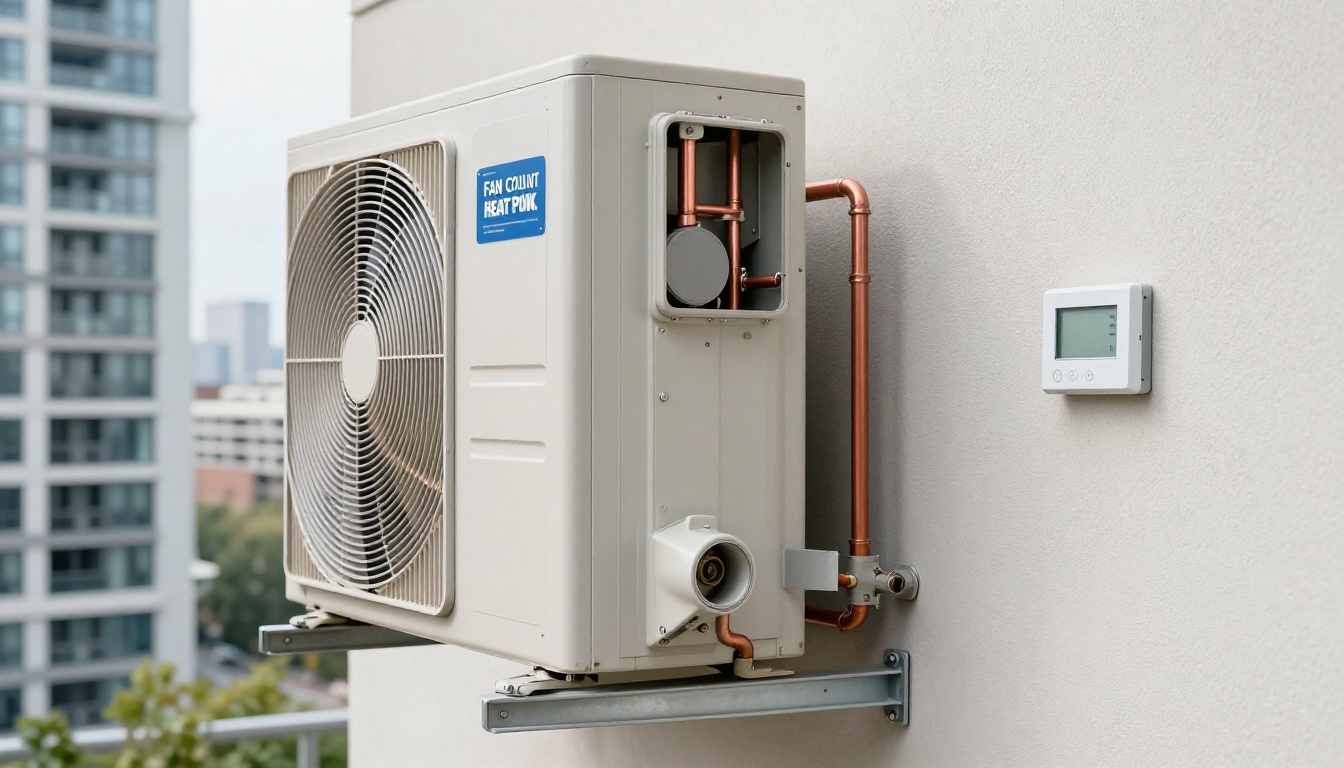
Some newer condominiums use in-suite heat pumps, often water-source heat pumps connected to a building loop. These units can provide both heating and cooling more independently than a basic 2-pipe fan coil, but they also have more components that can fail, including compressors, reversing valves, boards, sensors, and condensate controls.
In practice, heat pumps are great when maintained properly, but they are less forgiving of deferred service. Hudson often sees dirty coils and drain issues reduce performance long before a full breakdown happens. If you are buying in a newer Toronto or Mississauga building with this setup, ask whether the unit has had regular heat pump maintenance or prior heat pump repair or replacement.
ERVs and make-up air
Many condo owners do not realize their suite’s fresh air may come from a separate ERV or from a building-wide make-up air system. If ventilation is poor, you may notice stale air, lingering cooking odours, or winter dryness that seems worse than it should be. In tighter newer buildings, ventilation problems can affect comfort just as much as heating output.
An ERV is not the same thing as your heating or cooling unit, but it matters. In fall, before windows stay closed for winter, ERV maintenance can prevent airflow complaints that residents often mistake for heating failure.
A buyer’s field checklist: what to inspect before closing
1. Find the unit and identify the equipment type
If you cannot identify the HVAC equipment during a showing, that is already useful information. In many condos, the fan coil or heat pump is hidden behind a louvered door or in a utility closet. Look for a manufacturer label, approximate age, and any service stickers. Common brands and configurations in GTA condos include Carrier 42 series fan coils, Daikin water-source heat pumps, older IEC and McQuay equipment, and various custom high-rise console units.
A useful rule of thumb: if the suite equipment is more than 15 to 20 years old and there is no maintenance history, assume there is deferred cost coming. Some units last longer, but blower motors, actuators, drain pans, and control boards do not age gracefully in neglected closets. If the building is discussing a large fan coil retrofit project or heat pump replacement project, that should become part of your purchase math.
2. Look for signs of water, rust, and microbial growth
The most expensive condo HVAC problems often start as small moisture issues. Check the floor of the closet, the bottom lip of the cabinet, and the area around the drain pan. Rust flakes, staining, swollen baseboards, or a musty smell can indicate a long-term condensate problem.
In Toronto condos, one of the most overlooked issues is a partially clogged drain pan or line that only leaks during high humidity in summer. By fall, the area may look dry, but the corrosion remains. If there is any sign of prior leakage, drain pan cleaning and repair or even HVAC mold remediation may be needed.
3. Check the filter condition, not just the thermostat display
A thermostat that lights up proves almost nothing. Instead, ask to see the filter. On many fan coils, the filter sits behind the lower access panel or front return grille. If it is a 1-inch or 2-inch pleated filter and you cannot see light through it, airflow has been compromised for a while. Restricted airflow increases blower motor load, reduces heat transfer, and can cause nuisance noise that buyers often mistake for “normal condo sounds.”
A severely loaded filter also tells you something about ownership habits. If that basic item has been neglected, there is a reasonable chance the coil, drain pan, and valve train have been neglected too. Annual fan coil maintenance is one of the easiest ways to prevent this chain reaction.
4. Listen for specific noises
Different noises point to different failures:
- High-pitched whine: often worn blower motor bearings
- Clicking every 10-15 seconds: commonly a failing actuator trying to seat
- Buzzing with little airflow: weak motor, capacitor issue, or seized wheel
- Water trickling after cooling season: residual drain issue or trap problem
- Cabinet rattling on startup: loose access panel, blower imbalance, or vibration isolation issue
In the field, Hudson sees buyers ignore intermittent clicking because the suite still reaches temperature. A month later, the valve sticks open or closed and the unit either overheats or stops heating entirely. That is when actuator replacement, three-way valve replacement, or blower motor repair becomes unavoidable.
The building-level questions that matter more than most buyers think
Even if your suite equipment looks decent, the building can still make or break your comfort. Ask the seller, property manager, or status certificate reviewer these questions:
- Is the building 2-pipe or 4-pipe? A 2-pipe building means seasonal changeover and less flexibility.
- When does the building typically switch from cooling to heating? In Toronto, many buildings target mid-October, but weather swings can make this contentious.
- Have there been recent boiler, chiller, or riser issues?
- Is there a reserve fund plan for major HVAC assets?
- Are suite fan coils owner responsibility or corporation responsibility?
- Has the building done riser replacement, balancing, or control upgrades?
One common mistake first-time buyers make is treating the status certificate as a legal formality rather than a mechanical clue. If there are repeated resident complaints about overheating, poor changeovers, or leaks from vertical stacks, that can point to larger issues such as aging isolation valves, poor hydronic balancing, or deferred central plant work. In some older towers, riser replacement, boiler replacement, or broader mechanical maintenance becomes a major board discussion because the suite-level complaints are really symptoms of building infrastructure fatigue.
For buyers looking specifically in Toronto, it is worth reviewing a local specialist page like condo HVAC repair in Toronto, and if you are comparing nearby markets, condo HVAC repair in North York or condo HVAC repair in Mississauga can help you understand the kinds of systems common in those submarkets.
What you can do right after move-in, especially in fall
October is one of the best months to get ahead of HVAC issues in a condo. The system is not yet under peak winter demand, and technicians can still catch weak components before the first cold snap.
Safe first steps for owners
- Remove the lower access panel if your building permits owner access.
- Locate the filter and inspect it against a light source.
- Vacuum dust from the return grille and around the cabinet base.
- Make sure furniture is not blocking supply air discharge.
- Test thermostat mode changes and fan speeds.
- Confirm whether the building has completed heating switchover.
- Check for lint accumulation if your suite has an in-unit dryer nearby.
That last point matters more than buyers expect. In many condo layouts, the HVAC closet and laundry area share a small utility zone. Excess lint can migrate into return air areas and accelerate coil fouling. Dryer vent cleaning is not just a laundry issue; in tight condo suites, it can indirectly affect indoor air quality and airflow performance.
For a full baseline after possession, booking annual in-suite maintenance is one of the smartest first-year moves a buyer can make. Hudson often finds small issues during these visits that are inexpensive in October and urgent by January.
Repair or replace? A practical decision framework for buyers and new owners
The right answer depends on equipment age, repair history, noise level, and whether the building itself is stable mechanically.
| Situation | Usually repair | Usually replace | Why |
|---|---|---|---|
| 5-12 year old fan coil with one bad actuator | Yes | Rarely | Targeted repair is cost-effective if coil and cabinet are clean |
| 15-20 year old fan coil with rusted drain pan and noisy motor | Sometimes | Often | Multiple aging parts usually mean repeat service calls |
| Heat pump with board issue but good compressor | Yes | Sometimes | Repair may buy several years if refrigerant circuit is healthy |
| Original equipment in 1990s condo with repeated leaks | Rarely | Often | Deferred corrosion tends to accelerate once leaks begin |
| Building planning suite-wide retrofit in 1-2 years | Often temporarily | Depends | Short-term repair may make sense until project starts |
A key condo-specific insight: replacement is not always just a unit-owner decision. Access rules, approved contractors, shutoff coordination, crane logistics for some equipment, and corporation standards can all affect timing. In some buildings, a straightforward fan coil replacement takes 2-3 hours in-suite once isolation is confirmed; in others, coordination with management extends the process significantly.
For larger properties, Hudson also supports project planning and retrofit work, including fan coil retrofit and heat pump replacement programs that boards often phase over several months.
What a service visit typically looks like in a Toronto condo
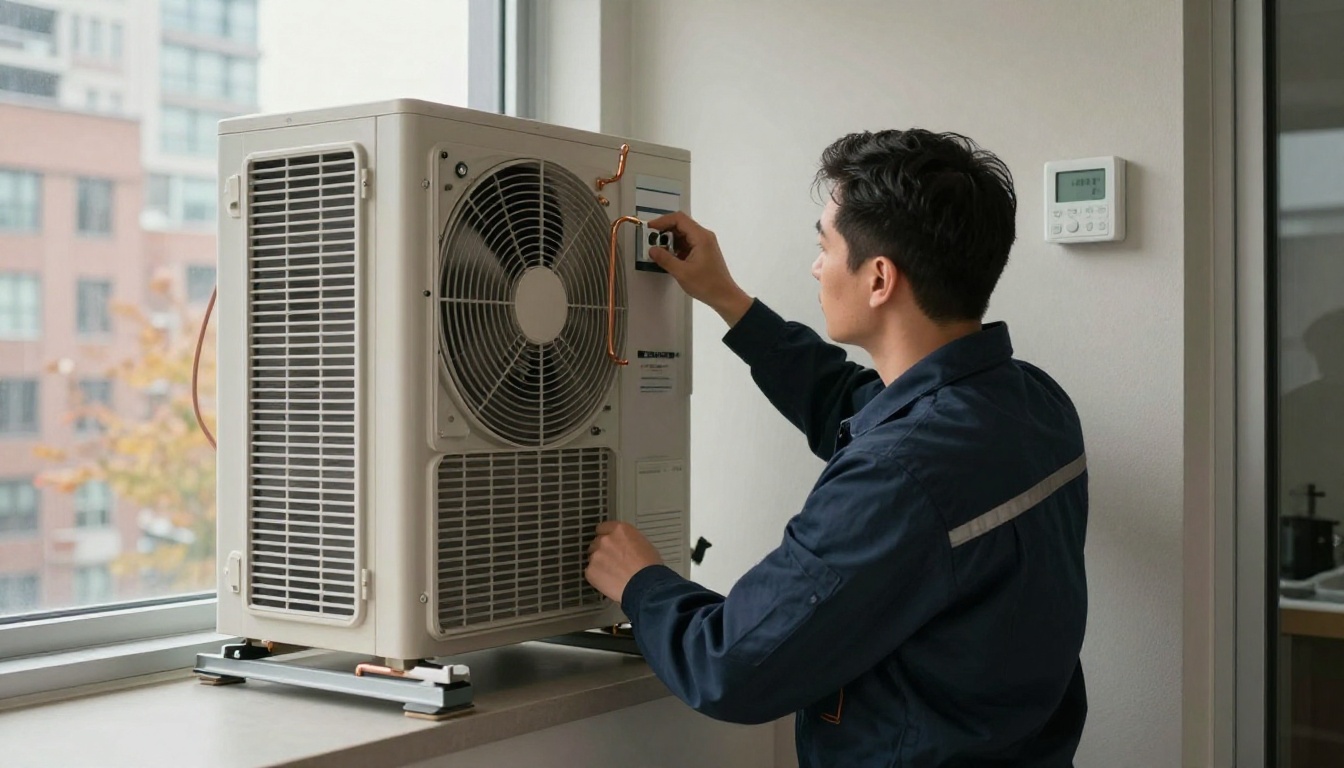
A proper condo HVAC service call is more than “it turns on.” In a well-run visit, the technician should:
- Verify thermostat call and control sequence
- Check entering and leaving air temperatures
- Inspect valve operation and actuator travel
- Measure blower amperage and listen for bearing noise
- Inspect filter, coil cleanliness, and drain pan condition
- Confirm condensate drainage and look for microbial buildup
- Check for cabinet vibration and duct leakage
- Document whether the issue is suite-level or building-level
A straightforward diagnostic usually takes 45 to 90 minutes. Minor repairs may be completed in the same visit if parts are available. More involved work, such as a motor change or valve replacement, often takes 1.5 to 3 hours depending on access and whether the building needs isolation coordination.
This distinction matters because many first-time owners assume every comfort complaint is an emergency inside their suite. In reality, some issues need emergency HVAC repair, while others trace back to a central heating loop, common-area controls, or overdue comprehensive mechanical maintenance at the building level.
Real Toronto cost ranges first-time buyers should know
These are realistic 2026 GTA ranges for common condo HVAC work. Actual pricing varies by building access, after-hours requirements, equipment type, and parts availability.
Common in-suite service costs
- Diagnostic/service call: $180-$350
- Annual fan coil maintenance: $220-$420
- Annual heat pump maintenance: $250-$450
- Thermostat replacement: $250-$450
- Actuator replacement: $350-$600
- 3-way valve replacement: $650-$1,200
- Drain pan cleaning/repair: $300-$700
- Blower motor repair/replacement: $550-$1,200
- HVAC mold remediation in a closet unit: $500-$1,500 depending on contamination extent
Replacement ranges
- Fan coil replacement: typically $3,500-$7,500 per suite
- In-suite heat pump replacement: often $5,500-$10,000+ depending on model and controls
- Building-wide fan coil program: often 4-6 months for a 250-300 unit property, longer if access rates are poor
One original insight buyers rarely hear: labour costs in condos are driven less by wrench time and more by logistics. Elevator booking, parking, security sign-in, suite access windows, and water isolation coordination can add real cost. That is why two apparently identical repairs can price differently in downtown Toronto versus a more accessible mid-rise in Mississauga.
Condo HVAC myths that cause expensive mistakes
“If air is blowing, the HVAC is fine.”
Not true. Airflow without proper water temperature, valve function, or heat pump staging can mean the fan is running while the unit is delivering little useful heating. Many owners discover this only when outdoor temperatures drop below 5°C and the suite can no longer recover overnight.
“The building handles everything mechanical.”
Sometimes, but not usually. Most condos split responsibilities. Your suite fan coil, thermostat, filters, and many repair costs may be yours even if the heating source is central. Always check the declaration.
“Smart thermostats are always an upgrade.”
In condo HVAC, the wrong thermostat can create more issues than it solves. Compatibility matters, especially with fan speed control, line-voltage setups, and proprietary boards. If you are considering a change, use a qualified thermostat installation and replacement service rather than guessing.
“No leaks means no moisture problem.”
Not necessarily. Drain pans can hold stagnant water, and microbial growth can remain hidden under insulation or inside the cabinet. By the time a visible leak appears, the corrosion has often been developing for several seasons.
FAQs
What HVAC system do most Toronto condos use?
Most Toronto condos use either a fan coil unit, an in-suite heat pump, or a water-source heat pump tied into the building’s central mechanical system. Buildings from the 1980s to early 2000s often have 2-pipe fan coil systems, which means the whole building is switched seasonally between heating and cooling; many newer towers use 4-pipe systems or heat pumps that allow better year-round control. In Hudson HVAC’s experience, first-time buyers often assume every suite has independent heating and cooling, but in many condos the suite equipment still depends heavily on building-level boilers, chillers, pumps, and changeover schedules.
How much should a first-time condo buyer budget for HVAC repairs in Toronto?
A realistic annual budget for minor HVAC issues in a Toronto condo is roughly $250 to $800, depending on the age of the equipment and whether maintenance has been done regularly. Common repairs include thermostat replacement at about $250 to $450, actuator replacement around $350 to $600, blower motor repairs often $550 to $1,200, and fan coil leak-related drain pan service typically $300 to $700. Full in-suite equipment replacement is a different category entirely, with fan coil retrofits often landing in the $3,500 to $7,500 range per suite and heat pump replacements often higher.
What should I inspect before buying a condo with a fan coil or heat pump?
Ask for the equipment age, service history, and whether the unit has had annual maintenance, because neglected condo HVAC can look fine during a showing but fail under winter load. Open the mechanical closet if permitted and check for rust around the drain pan, staining on the cabinet base, a dirty filter, vibration marks, and handwritten service dates; these small clues often reveal more than the thermostat display does. Also ask whether the building has had recent riser work, chiller or boiler issues, or frequent seasonal changeover complaints, because a perfectly good suite unit can still perform poorly if the central plant is struggling.
Is condo HVAC maintenance really necessary if the system seems to work?
Yes, because condo HVAC problems usually build slowly and then show up at the worst time, especially during Toronto’s first real cold snap in November or December. A system can still blow air while hiding a sticking actuator, a partially blocked coil, a weak blower capacitor, or microbial growth in the drain pan that will become a leak issue next cooling season. Hudson commonly sees first-time owners spend far more on emergency calls than they would have on annual in-suite maintenance, especially in older North York and Mississauga buildings where original equipment is still running beyond its expected lifecycle.
Can I replace my condo thermostat with any smart thermostat?
No. Many condo fan coils and heat pumps use low-voltage control schemes, line-voltage thermostats, proprietary boards, or staging logic that is not compatible with off-the-shelf smart thermostats. Installing the wrong thermostat can cause short cycling, loss of heating calls, fan issues, or even damage to control components, so compatibility should be confirmed before replacement. In condo applications, Hudson often finds Honeywell, Aube, Unilux-compatible, or custom control setups where proper wiring and programming matter more than the thermostat brand name.
Who is responsible for condo HVAC repairs: the owner or the building?
It depends on the condominium declaration and bylaws, not just the location of the equipment. In many Toronto condos, the owner is responsible for the in-suite fan coil, heat pump, thermostat, and maintenance inside the unit, while the corporation handles central boilers, chillers, cooling towers, risers, and common-area mechanical systems. The important detail for buyers is that responsibility can split awkwardly—for example, your suite may be fine mechanically, but if a building riser valve fails or the seasonal switchover is delayed, comfort problems can still affect you.
Next steps for first-time buyers and new owners
If you are buying your first condo, do not wait until January to learn how the HVAC works. Before closing, identify the system type, inspect the closet, ask about building changeovers, and review maintenance history. After move-in, especially in fall, book a baseline inspection so small issues are found before Toronto winter exposes them.
If your suite has not had service in over a year, if the unit is noisy, if the filter is heavily loaded, or if the building has a history of inconsistent heating, now is the right time to act. Hudson HVAC provides condo-focused inspections, repairs, maintenance, and retrofit planning for high-rise and mid-rise buildings across Toronto and the GTA. For more condo-specific resources, you can also browse the Hudson HVAC blog.
Contact Hudson
For first-time condo buyers, owners, property managers, and boards looking for clear answers on suite equipment or building-wide mechanical concerns, Hudson HVAC is available to help.
- Contact Us
- Phone: +1 (437) 448-0640
- Email: service@hudsonhvac.ca