
Toronto New Condo HVAC Problems in Brand-New Buildings
New construction HVAC problems in Toronto condos are common. Learn the real causes, deficiency signs, costs, and when to call an expert.
- Hudson HVAC
- 18 min read
Toronto New Condo HVAC Problems in Brand-New Buildings
Quick summary: Brand-new condos in Toronto, North York, and Mississauga often have HVAC deficiencies that show up in the first heating or cooling season, not because the equipment is old, but because installation, commissioning, and turnover were rushed. If your new suite has weak heat, noise, leaks, humidity, or a thermostat that never seems accurate, the issue may be a builder defect, balancing problem, or control issue rather than “normal break-in.”
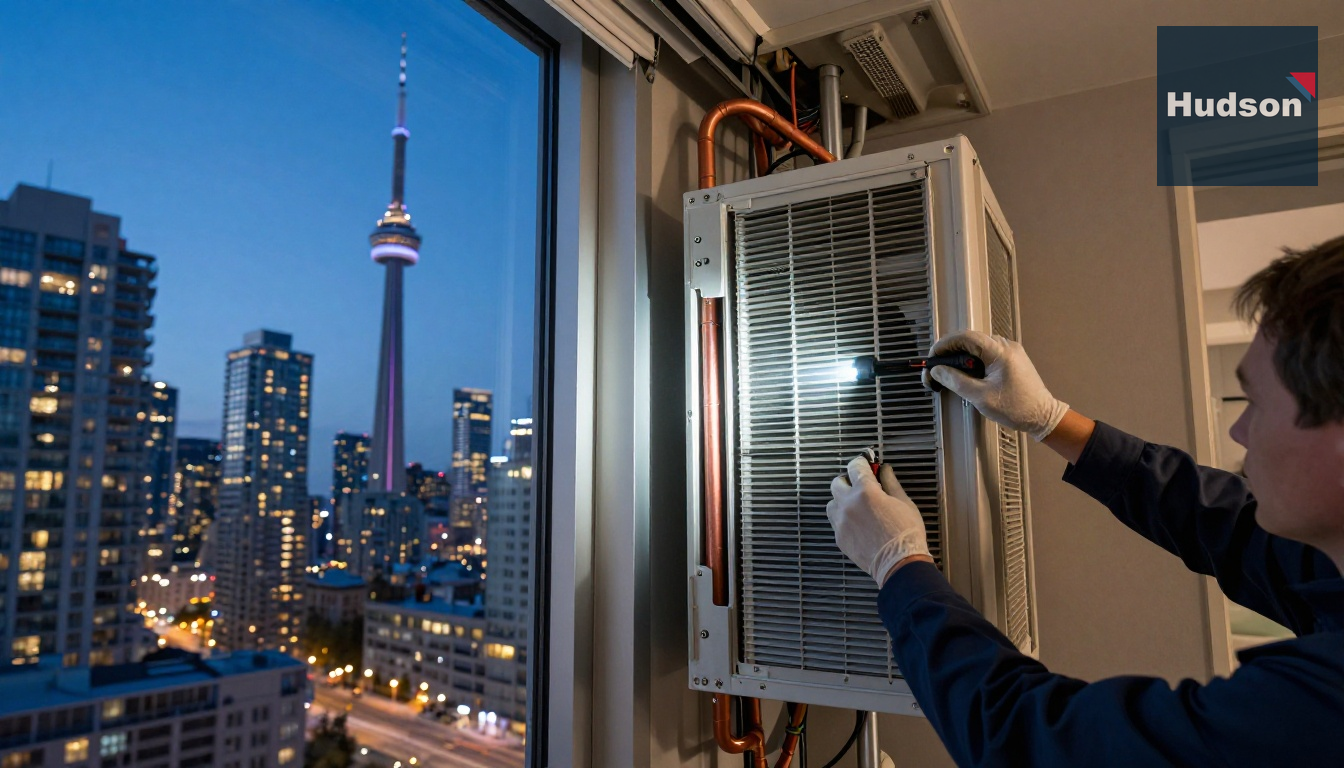
A lot of owners assume a new building should mean trouble-free comfort. In the condo world, that is rarely how it works. Hudson HVAC has serviced enough new-build towers across Toronto to say this plainly: some of the most frustrating HVAC calls come from buildings less than three years old. The equipment may be clean and shiny, but if the fan coil, heat pump, ERV, riser piping, or thermostat controls were installed carelessly, you can end up with a unit that never performs properly from day one.
The pattern Hudson sees in new Toronto condos
One of the biggest myths in condo living is that older buildings have problems and new buildings do not. In practice, older 80s and 90s towers in North York often have predictable wear issues, while brand-new towers in downtown Toronto or Mississauga can have a long punch list of unresolved deficiencies. The difference is that in older buildings, failures usually come from age. In new buildings, they usually come from handover pressure, rushed subcontractors, incomplete commissioning, and construction debris left inside the system.
In our experience servicing Toronto condos, the first fall and winter after occupancy reveal the most complaints. That is when owners discover their suite won’t hold 22°C when outdoor temperatures drop to 0°C or below, or that one bedroom is 4-6 degrees cooler than the living room. That temperature spread is not just annoying; it usually points to low airflow, poor balancing, perimeter heat loss, or a control valve that never opens fully.
A typical new-construction service call often starts with symptoms like:
- The thermostat says heat is on, but the air feels lukewarm
- The suite heats unevenly, especially rooms near glazing
- The fan coil runs constantly but never reaches setpoint
- There is a click every 10-15 seconds from the unit closet
- Water appears around the fan coil during cooling season
- The ERV is noisy or seems to do nothing
- The bedroom is stuffy even with windows closed
- The dryer takes 70-90 minutes to dry a normal load
Many of these issues trace back to items Hudson handles every day, including fan coil repair and replacement, thermostat installation and replacement, and full in-suite maintenance for condo units.
A second pattern worth knowing: new condo problems are often stack-related, not isolated. If three suites above each other on the same exposure all report weak heat, there is a good chance the cause is in shared piping, balancing, controls, or riser configuration rather than three separate bad fan coils. That matters because owners can waste months replacing suite-level parts when the real problem lives in the common system.
What is actually going wrong in brand-new buildings?
The phrase new construction HVAC problems sounds broad, but the failures are usually very specific. Hudson sees the same handful of issues repeat across new high-rise condos in Toronto, North York, and Mississauga.
1. Poor commissioning and balancing
A condo HVAC system is not “finished” when the equipment is installed. It still has to be commissioned: water flow verified, controls checked, thermostats calibrated, airflow measured, and suites balanced. In many new builds, that process is compressed near occupancy. The result is a building that technically turns on, but never performs consistently.
For example, in a 4-pipe fan coil building, the suite may have separate heating and cooling coils with control valves that should modulate properly. If the balancing contractor never set the design flow, one unit may receive 2.5 GPM while another gets 0.8 GPM, even though both were designed for similar loads. Owners only notice later when one suite overheats and another cannot recover on a cold November morning.
This is where broader mechanical maintenance and comprehensive maintenance programs become important for boards and managers, because early trend data often shows whether the issue is local or building-wide.
2. Actuators and valves that are new but already failing
One common mistake we encounter in newer high-rises is assuming a new actuator cannot be bad. It absolutely can. We routinely find 24V spring-return actuators that are miswired, stalled, or unable to fully stroke the valve body. A repeated clicking sound every few seconds often means the actuator motor is trying to seat but cannot.
On many condo fan coils, the problem is not the blower at all but the water side. If the 2-way or 3-way valve is stuck closed, the blower can run all day and still deliver cool or neutral air. That is why a proper diagnosis often involves checking pipe temperatures, valve travel, and control signal voltage, not just swapping the thermostat. Hudson handles these issues through actuator replacement and 3-way valve replacement when required.
3. Construction dust choking the system before move-in
This is one of the least understood condo issues. During construction, drywall dust, concrete dust, sawdust, and packaging debris can get pulled into the return side of a fan coil or ERV long before occupancy. A filter that looks “new” can already be loaded enough to reduce airflow by 20-35%.
That matters because low airflow creates a chain reaction: poor heat delivery in winter, coil icing or sweating in shoulder seasons, noisy operation, and higher blower amperage. In buildings with compact vertical fan coils, that dust also coats blower wheels and can throw them slightly out of balance. Hudson frequently resolves “brand-new noisy unit” complaints with a combination of fan coil maintenance and blower motor repair when the wheel or motor has already been affected.
4. Condensate drainage installed incorrectly
A new condo leaking water is almost never “just because it’s humid.” In new buildings, the usual causes are a poorly sloped drain line, missing trap, blocked drain tee, shipping debris in the pan, or a cabinet installed slightly out of level. Even a quarter-inch tilt in the wrong direction can leave standing water in part of the pan.
In Toronto’s fall shoulder season, this often shows up when daytime temperatures still trigger cooling but nights are cool enough to reduce run time. The intermittent operation allows small drainage defects to become visible. If your system has leaked even once, do not ignore it. Water in a condo closet can affect flooring, drywall, insulation, and indoor air quality quickly. Hudson deals with this through drain pan cleaning and repair and, where needed, HVAC mold remediation.
5. Thermostat placement and control logic problems
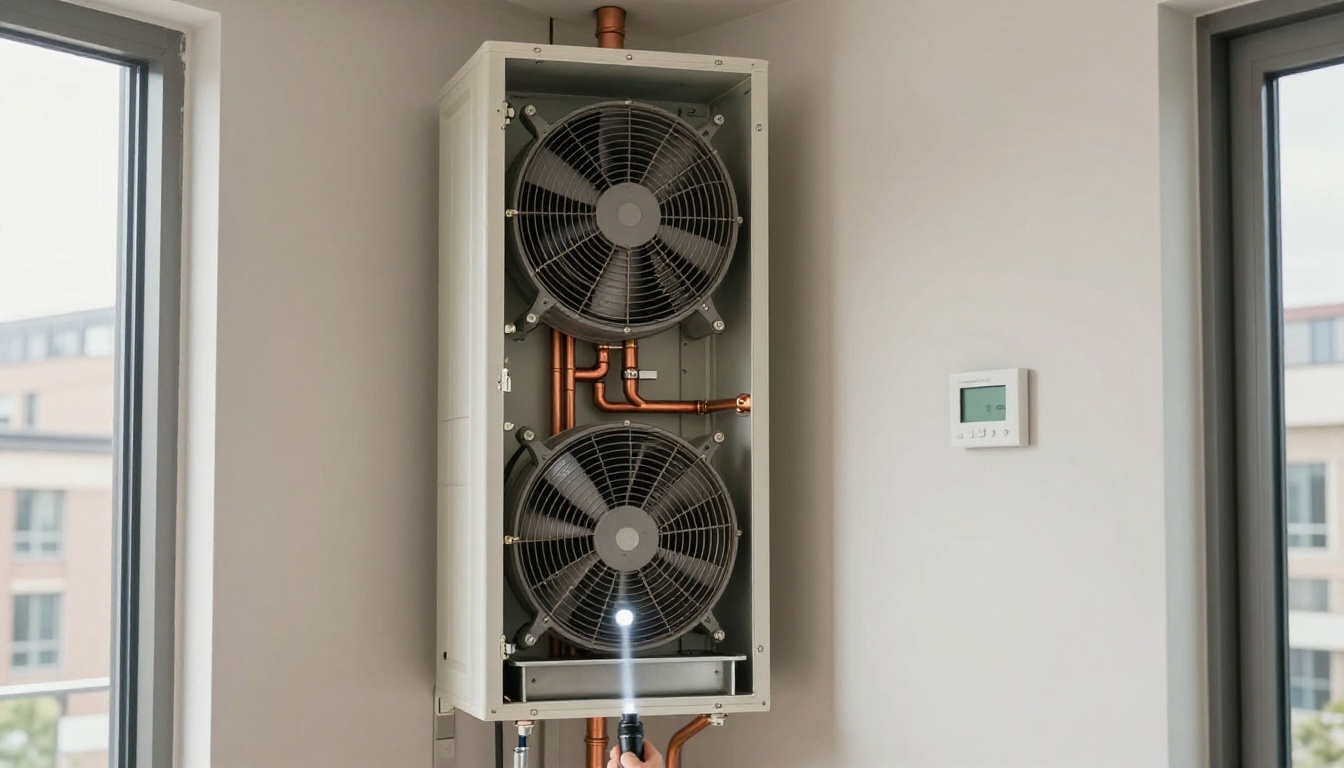
Another issue owners rarely suspect is thermostat location. In some new suites, thermostats are mounted on walls affected by solar gain, corridor pressure, or exterior drafts. A thermostat near a south-facing window wall can read high in the afternoon, shutting off heat early. One near a drafty entry or poorly sealed exterior wall can read low and overheat the suite.
We have also seen control sequences programmed incorrectly in newer integrated systems where the fan runs continuously but the valve never receives the proper call. If your thermostat display changes but the equipment response does not, the problem may be in the relay board, low-voltage wiring, or BMS interface rather than the thermostat itself. That is why thermostat replacement services should include actual control verification, not just installing a prettier wall control.
6. Ventilation problems that feel like heating problems
In new airtight buildings, poor ventilation often gets mistaken for poor heating. If the ERV is not commissioned properly, or if suite exhaust and corridor make-up air pressures are off, residents may feel cold drafts, stale air, or persistent window condensation. In reality, the fan coil may be doing its job while the ventilation side is undermining comfort.
This is especially common in shoulder seasons and the first winter. Hudson has seen this in waterfront and exposed towers where pressure differences across the building create noticeable infiltration around entry doors and window interfaces. Proper ERV maintenance and building-level review can make a suite feel warmer even without changing the heat source.
The fall checklist: what condo owners can do right now
October is exactly when new condo owners should get proactive. Once Toronto gets its first sustained cold stretch, service queues get longer and builder trades become harder to pin down. Before that happens, there are several safe checks you can do yourself.
Start with the fan coil or heat pump closet
If your suite has a vertical fan coil cabinet, open the lower or front access panel if your building permits resident access. In many condos, the filter is a 1-inch or 2-inch pleated filter behind the intake section. Slide it out and hold it up to light. If you cannot see light through a large portion of the media, it is restricting airflow enough to affect performance.
If the unit has a washable mesh filter instead of pleated media, rinse it fully and let it dry before reinstalling. A surprising number of “new condo heating complaints” are made with the filter still wrapped in construction dust. If you are unsure, book annual fan coil maintenance or heat pump maintenance before winter.
Check your thermostat properly
Do not just raise the setpoint and listen for a fan. Set the thermostat 2-3°C above room temperature and wait several minutes. Put your hand near the discharge grille, but also check the piping if accessible without touching electrical components. In heating mode, the entering hot-water pipe should usually feel noticeably warm to hot once the valve opens. If the fan runs but the pipe stays cool, that points to a valve, actuator, or building-side supply issue.
Also note how long the unit runs. In a typical Toronto condo, a properly operating suite-level unit should not need to run continuously for hours just to recover from 21°C to 23°C in mild fall weather. Long run times in October often predict serious winter complaints in January.
Look for signs of hidden drainage issues
Even though fall is heating-prep season, inspect around the base of the unit for:
- staining on flooring or baseboards
- rust marks on the cabinet bottom edge
- musty smell near the closet
- water marks inside the access panel
- insulation on chilled-water lines that looks damp or split
If you see any of those, schedule drain pan cleaning and repair before spring. A small drainage defect now often becomes a mold complaint later.
Do not ignore the dryer and ventilation side
In new condos, dryer vent issues are more common than people think. Long vent runs, crushed flex, lint at terminations, and weak booster performance can leave suites humid and uncomfortable. If your dryer takes more than one cycle for normal loads, or the laundry closet gets unusually warm, book dryer vent cleaning. That is not only a comfort issue; it is also one of the simplest fire-risk reductions an owner can make before winter.
For Toronto owners wanting a suite-wide checkup rather than guessing at one symptom at a time, in-suite HVAC maintenance is usually the most efficient first step.
When it is probably a deficiency, not routine maintenance
There is a practical line between “this needs annual service” and “this looks like a builder defect.” The most common signs of a new condo HVAC deficiency are patterns that repeat despite basic maintenance or affect multiple suites.
Call a professional if you notice any of the following:
- Your suite cannot maintain temperature within ±1.5°C in normal fall conditions
- One room is consistently 3-6°C different from another
- The fan coil clicks repeatedly but heat output does not change
- The blower makes a high-pitched whine, which often suggests bearing issues, not normal operation
- The cabinet vibrates against framing or closet finishes
- You have had more than one leak event in the first year
- Several units on the same line or floor report the same complaint
- Condensation forms heavily on windows even when indoor humidity is not excessive
At that point, a proper diagnosis matters more than another generic service call. If the building is occupied and winter is approaching, delaying can turn a manageable deficiency into an emergency no-heat situation. Hudson offers emergency HVAC repair for urgent failures, but fall is the better time to catch problems before the first true cold snap.
For local context, owners in downtown Toronto towers often deal with control and balancing issues, while newer buildings in North York and Mississauga can also show ventilation pressure and envelope-related comfort complaints because of exposure, glazing, and stack effect. If you need location-specific support, Hudson also provides condo HVAC repair in Toronto, North York condo HVAC service, and Mississauga condo HVAC repair.
What a proper service visit should include in a new building
A weak service visit on a new condo usually looks like this: thermostat changed, filter glanced at, resident told to “monitor it.” That is not enough. In a brand-new building, the goal is to determine whether the issue is suite-level, stack-level, or building-level.
A proper diagnostic visit should include most of the following:
- Thermostat verification – confirming call for heat/cool and control response
- Supply air temperature check – measuring discharge temperature, not guessing by feel
- Pipe temperature check – verifying hot/chilled water is actually reaching the coil
- Actuator and valve inspection – checking stroke, seating, and voltage
- Filter and coil condition review – looking for construction dust or restricted airflow
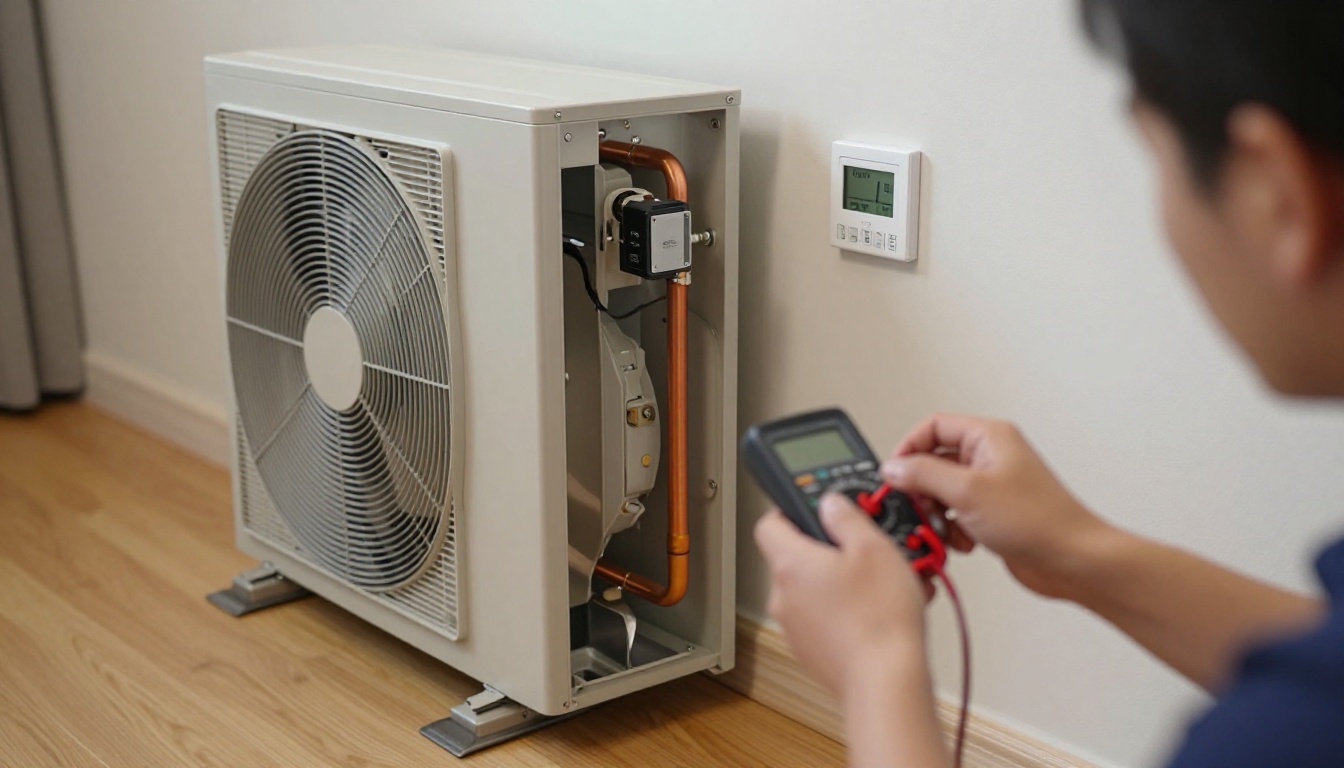
- Blower assessment – listening for bearing noise, checking capacitor/amperage where applicable
- Drain and pan inspection – especially if any leak history exists
- ERV or ventilation review – where comfort symptoms suggest pressure or stale air issues
- Building pattern review – asking whether neighbouring suites have similar complaints
A straightforward condo diagnostic typically takes 45-90 minutes if access is smooth. If management approval, mechanical room coordination, or stack investigation is required, it can take longer. For boards dealing with repeated deficiencies across many suites, Hudson often recommends tying suite findings into a broader mechanical maintenance program or, where systems are fundamentally flawed, planning future fan coil retrofit projects.
Real Toronto cost ranges: diagnosis, repair, and bigger fixes
Condo owners and boards usually want the same thing: is this a small repair, or is this the start of a bigger project? Here are realistic GTA ranges Hudson sees in 2026 for in-suite condo work.
Typical suite-level service costs
- Diagnostic visit: $180-$350
- Thermostat replacement: $250-$550 depending on model and wiring complexity
- Actuator replacement: $350-$600 including labour in most condo fan coil applications
- 3-way valve replacement: $550-$950 if isolation and access are straightforward
- Blower motor repair/replacement: $500-$1,100 depending on motor type and cabinet access
- Drain pan cleaning/repair: $250-$650
- Fan coil deep maintenance/cleaning: $250-$500 per unit
- ERV service: $220-$450 per suite
- Emergency after-hours no-heat call: often $300-$700+ depending on timing and parts
These ranges assume normal in-suite access in Toronto or nearby GTA markets. Costs can rise in luxury towers with difficult millwork access, restricted service hours, or special management requirements.
Building-wide implications
If a deficiency is widespread, the economics change. For example:
| Issue | Small repair approach | Larger project approach | When the project makes more sense |
|---|---|---|---|
| Repeated fan coil failures | Replace individual motors/actuators | Fan coil retrofit | When many units show the same defects or parts access is poor |
| Chronic temperature imbalance | Revisit suite controls | Building balancing and mechanical review | When entire stacks or exposures are affected |
| Leaks tied to aging risers or poor piping | Patch isolated points | Riser replacement | When multiple leak events occur across floors |
| Weak central seasonal performance | Tune suite units | Chiller maintenance or boiler replacement planning | When the source plant is the bottleneck |
A 250- to 350-unit condo with recurring suite complaints can spend tens of thousands of dollars chasing symptoms if nobody identifies the root pattern. That is one reason experienced condo-focused contractors matter. A house HVAC company may fix a thermostat but miss the fact that the entire east stack is underflowing.
Repair, document, or escalate? A simple decision framework
For owners dealing with a builder defect HVAC Toronto situation, this is the practical question: should you just fix it, or should you document it for warranty and management action?
Usually repair immediately
- No heat in cold weather
- Active water leak
- Burning smell or electrical fault
- Loud mechanical noise getting worse
- Fan not running at all
In those cases, comfort and property protection come first. Use emergency HVAC repair if needed, then document what was found.
Repair and document
- Repeated thermostat issues
- Actuator or valve failures in a new building
- Drainage defects that appear tied to installation
- Significant room-to-room imbalance
- Ventilation complaints affecting comfort
This is often the sweet spot. Get the suite operating properly, but keep records for management, the board, or warranty follow-up.
Escalate as a likely building issue
- Multiple suites on one stack have the same problem
- The suite unit tests fine but comfort is still poor
- Water temperatures or pressure are inconsistent by floor or exposure
- Seasonal changeover creates the same complaints every time
- There are repeated leak patterns across many units
When that happens, the conversation should move beyond a single unit and toward building operations, common elements, and capital planning. Hudson’s projects team is often brought in when a condo has already learned the hard way that repeated one-off repairs are not solving the root issue.
FAQs
Is it normal for a brand-new condo HVAC system to have problems?
Yes, more often than most owners expect. In Hudson HVAC’s experience servicing Toronto-area new-build condominiums, the first 12-24 months often reveal deficiencies that were hidden during construction turnover, including miswired thermostats, stuck actuators, poorly trapped condensate drains, unbalanced airflow, and fan coil units shipped with damaged blower wheels or loose control boards. A system can be brand-new and still be installed incorrectly, commissioned poorly, or affected by construction dust that clogs coils and filters before the owner even moves in.
What HVAC issues in a new condo are usually builder deficiencies versus normal maintenance?
Builder-type deficiencies usually involve installation, design, or commissioning errors rather than wear and tear. Examples include reversed piping on a 2-pipe or 4-pipe fan coil, an unlevel drain pan that causes chronic leaking, disconnected ERV ducting, low airflow caused by crushed flex duct, thermostats placed on exterior walls near cold drafts, or suites that never reach setpoint because balancing dampers were never adjusted properly. Normal maintenance items are things like dirty filters, annual drain cleaning, and routine inspections, which are still needed even in year one.
How long should a new condo owner wait before reporting HVAC deficiencies?
Do not wait. If your suite has weak heat, temperature swings, unusual noise, or water around the unit, document it immediately with photos, videos, dates, thermostat settings, and outside weather conditions. In Ontario, timing matters because Tarion and builder warranty processes are date-sensitive, and issues reported during the first heating season are far easier to trace than complaints made a year later after multiple service visits and seasonal changeovers.
Why does a new fan coil or heat pump leak water if it has barely been used?
New equipment leaks most often because of installation defects, not age. Hudson commonly finds drain lines without proper slope, missing or poorly primed traps, shipping debris left in the drain pan, insulation gaps that create sweating on chilled piping, or fan coil cabinets installed slightly out of level so condensate pools at one corner. In Toronto’s shoulder seasons, especially during humid September and October weather, those small installation errors show up quickly when cooling still runs intermittently.
Can condo owners hire their own HVAC contractor during the builder warranty period?
Usually yes for diagnosis, but owners should coordinate carefully with property management and review warranty documentation first. An independent inspection from a condo-focused contractor can help determine whether the issue is a suite-level problem, a common-element problem, or a broader building commissioning issue affecting multiple units on the same riser or exposure. Hudson often documents findings in a way that helps owners, boards, and managers escalate legitimate deficiencies without guessing.
What does it cost to diagnose and fix new condo HVAC problems in Toronto?
A straightforward diagnostic visit in Toronto typically runs about $180-$350 depending on access, system type, and whether management coordination is required. Common repairs in newer condos include thermostat replacement at roughly $250-$550, actuator replacement around $350-$600, blower motor repair or replacement around $500-$1,100, and drain pan or condensate service around $250-$650. If the root issue is a building-wide balancing, riser, or control problem, costs can shift from a single-suite repair into a larger project involving the board or builder.
The practical next step before winter
If your condo is new and the HVAC has already given you one reason to doubt it, assume that the first real Toronto cold snap will test it harder than October ever will. A system that is merely “a bit weak” in fall often becomes a no-heat complaint in January. That is why the best time to act is before the seasonal rush.
For owners, the next step is simple: book a proper suite inspection, document symptoms clearly, and find out whether the issue is maintenance, a defective component, or a building-level deficiency. For property managers and boards, the bigger lesson is this: when similar complaints repeat across a new building, stop treating them as isolated service calls and start looking for a commissioning or common-element pattern.
If your fan coil, heat pump, thermostat, ERV, or drain system has not been inspected since occupancy, schedule service before winter arrives. Hudson HVAC specializes in condos, not houses, and understands the access, documentation, and shared-system realities that make new-build deficiencies different.
For more condo-specific guidance, visit the Hudson blog or book service with Hudson.
Contact Hudson
- Contact Us
- Phone: +1 (437) 448-0640
- Email: service@hudsonhvac.ca