
What a Condo HVAC Technician Does in Toronto Visits
Wondering what happens during a condo HVAC technician visit in Toronto? Here's a real, step-by-step breakdown of inspections, repairs, timing, and costs.
- Hudson HVAC
- 18 min read
What a Condo HVAC Technician Does in Toronto Visits
Quick summary: A proper HVAC technician visit in a condo is much more than swapping a filter or glancing at the thermostat. In Toronto condos, a good service call includes access coordination, electrical and airflow testing, drain and valve inspection, control checks, and a judgment call on whether the issue is inside the suite or tied to the building’s shared mechanical system.
If you’ve ever wondered what an HVAC tech does during a visit, this guide walks through the real process Hudson HVAC follows in Toronto, North York, Mississauga, and Etobicoke condos—especially in fall, when preventive service before winter saves the most money and resident frustration.
Why condo HVAC service visits are different from house calls
A condo service visit is not the same as servicing a detached home furnace in Scarborough or a rooftop unit in an industrial plaza. In a condominium, the technician is usually dealing with compact in-suite equipment—most commonly vertical fan coils, water-source heat pumps, ERVs, and wall thermostats—while also working around the reality that part of the system may be shared by the whole building.
That distinction matters. In our experience servicing Toronto condos, roughly 1 in 4 no-heat or no-cool complaints are not caused by the resident’s suite equipment alone. The problem may trace back to a seasonal changeover delay, low hot water temperature from the boiler plant, a control issue at the building level, or air trapped in a riser serving a stack of units. That is one reason condo owners and property managers often book in-suite HVAC maintenance alongside broader mechanical maintenance rather than treating every complaint as a one-off repair.
Another condo-specific issue is access. In many Toronto and North York high-rises, the fan coil is in a bedroom closet packed with storage bins, luggage, and cleaning supplies. A technician may spend the first 10 minutes just making the equipment safely reachable. In newer Etobicoke and Mississauga towers, access is often cleaner, but the systems may be more control-heavy, with communicating thermostats, condensate safety switches, and tighter clearances that make diagnostics more time-consuming.
The first 10 minutes: what happens before any tools come out
A professional visit starts with information gathering, not guessing. Before opening the cabinet, the technician should ask a few very specific questions:
- Is the unit not turning on at all, or is it running but not heating?
- Did the issue start after the building switched from cooling to heating?
- Is there a smell, leak, clicking sound, or intermittent shutdown?
- Has the filter been changed recently?
- Has the breaker tripped or the thermostat gone blank?
These questions are not filler. A clicking every 10 to 15 seconds often points to a failing actuator trying to drive a valve open or closed but never fully seating. A high-pitched whine usually suggests blower motor bearing wear rather than a thermostat issue. If the resident says the unit worked until the first cold weekend in October, that often points the technician toward changeover-related faults or a valve that has been stuck through the summer.
The next step is confirming whether the suite has a 2-pipe or 4-pipe system. This is one detail many competitors skip, but it changes the entire diagnostic path. Many older Toronto and North York condo buildings from the late 80s to early 2000s use 2-pipe fan coil systems, meaning the same piping serves either hot water or chilled water depending on the season. Newer builds are more likely to have 4-pipe systems, which can provide simultaneous heating and cooling. If a resident in a 2-pipe building complains that the unit is blowing cool air in October, the technician must verify whether the building has actually completed heating changeover before condemning the suite unit.
If your equipment has not been serviced recently, this is where a proper fan coil maintenance visit or heat pump maintenance appointment pays off: the technician already has a baseline condition to compare against.
Opening the unit: what the technician actually inspects
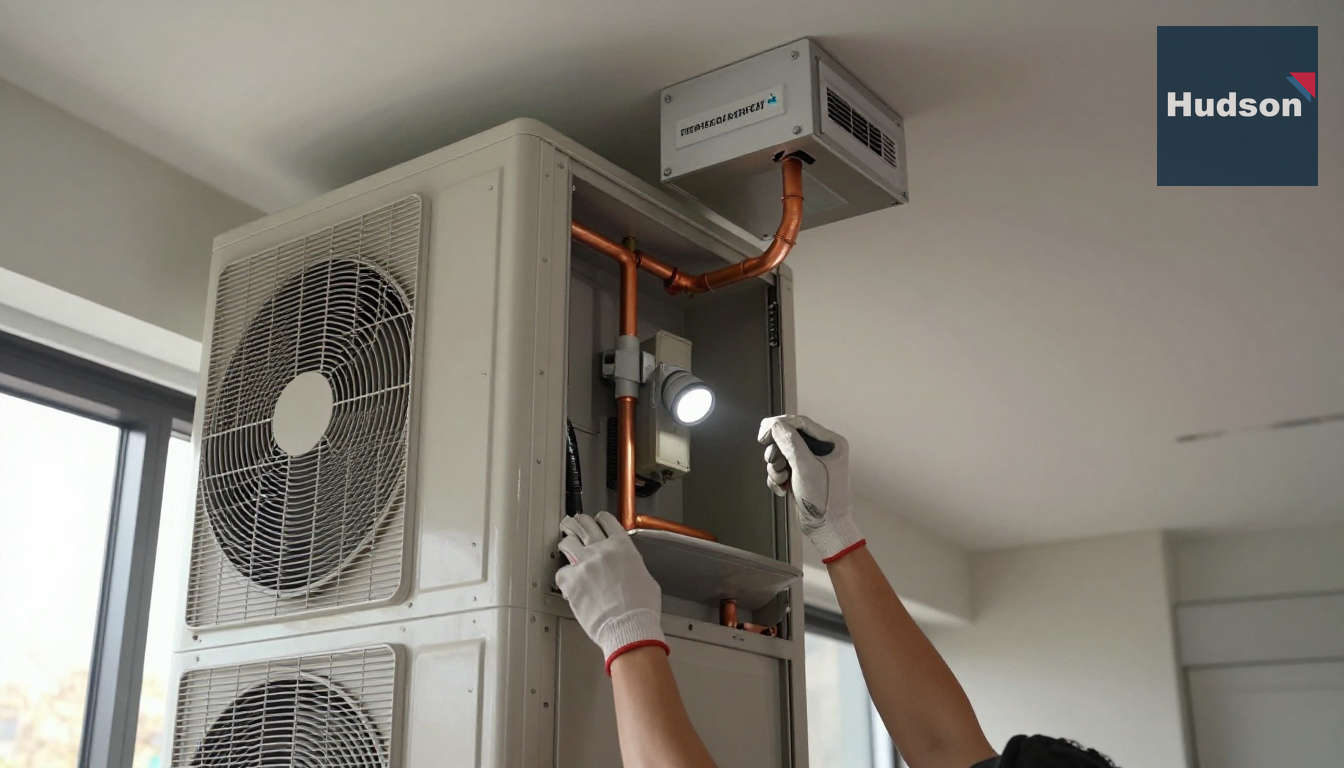
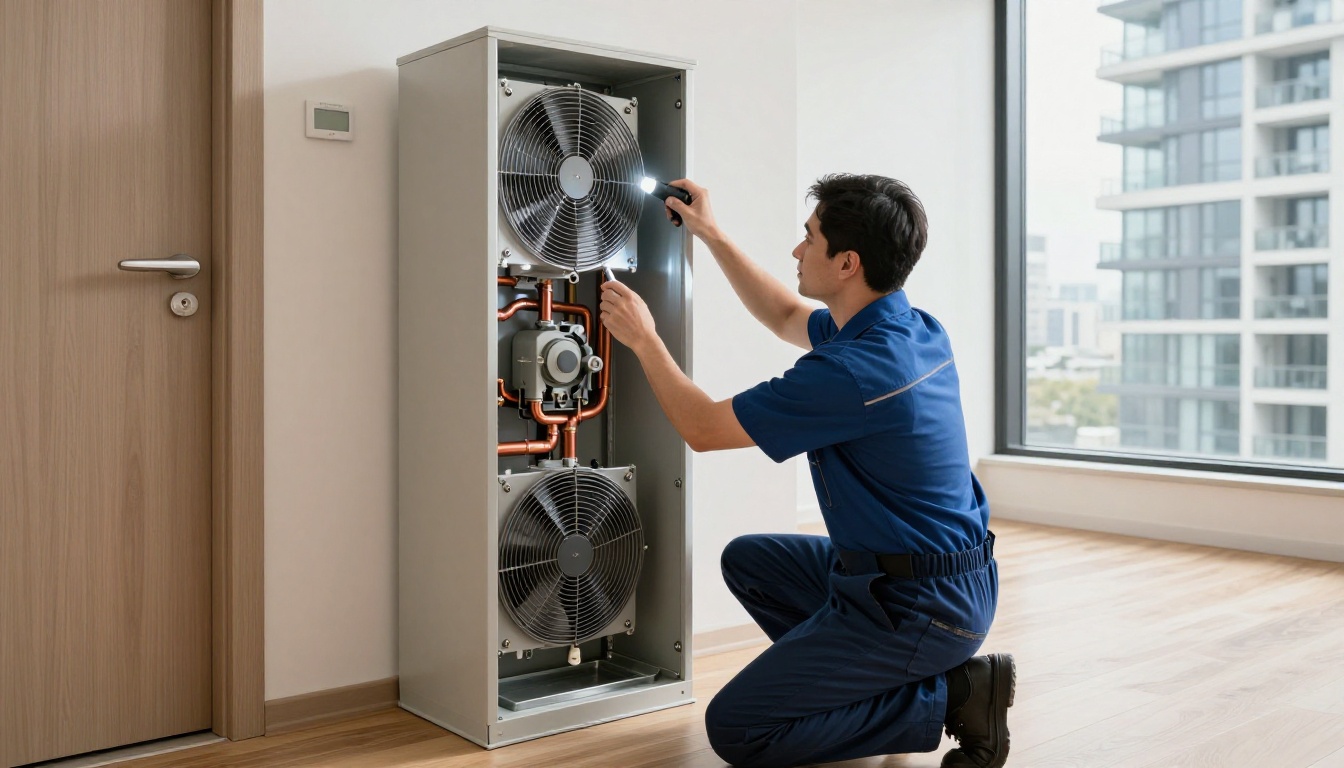
Once access is clear and power is safely managed, the real work begins. In most condo suites, the technician opens the lower and/or front access panel of the fan coil or heat pump cabinet and inspects several components in sequence.
1. Filter condition and airflow path
This sounds basic, but the filter tells an experienced tech a lot. In condo fan coils, the filter is often a 1-inch or 2-inch pleated filter located behind the lower access panel or return grille. If it is loaded with grey dust, pet hair, drywall dust, or cooking grease, airflow drops enough to reduce heating output dramatically.
What non-experts usually do not realize is that a dirty filter can also create secondary failures. Low airflow causes the blower motor to run hotter, can make electric heat safeties nuisance-trip in certain units, and in cooling season contributes to condensate overflow because the coil gets colder than intended. Hudson often pairs filter inspection with fan coil repair and replacement service when poor airflow has already started damaging other components.
2. Blower motor, wheel, and amperage draw
A technician should not just listen to the blower and move on. The blower motor is checked for:
- Bearing noise
- Shaft play
- Dirt loading on the wheel
- Capacitor condition where applicable
- Running amperage versus nameplate rating
In older condo buildings in North York, it is common to find blower wheels caked with fine dust that reduces airflow by 15% to 30% even though the motor still runs. That means the resident feels weak heat, assumes the thermostat is bad, and the real issue is a dirty airside assembly. If the motor is drawing high amperage or struggling to start, the technician may recommend blower motor repair before a cold-weather failure turns into a weekend emergency.
3. Coil, piping, and valve operation
In hydronic fan coils, the technician inspects the coil, copper piping, unions, and control valve assembly. Many Toronto condos use 24V actuators mounted on 2-way or 3-way valves. The actuator receives a call from the thermostat and opens the valve to let hot or chilled water flow through the coil.
A very common fall issue is a stuck 3-way valve that sat untouched through summer and now fails when heating is needed. Another is an actuator motor that hums or clicks but cannot complete its stroke. In practical terms, that means the blower runs, but the coil never gets hot enough. This is why experienced techs frequently test for temperature difference across the coil and verify actual valve movement instead of diagnosing by touch alone. If needed, Hudson handles both actuator replacement and 3-way valve replacement.
4. Thermostat and control circuit testing
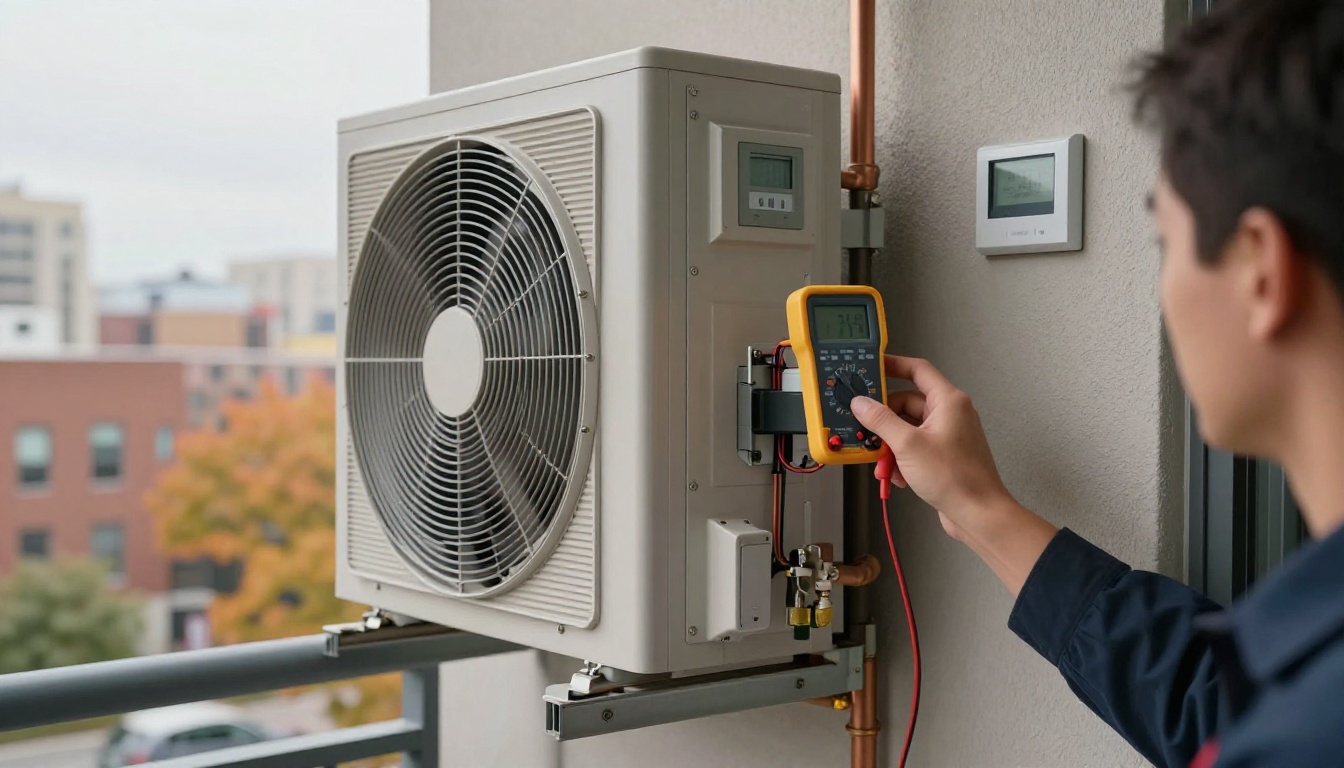
A thermostat can fail, but in condos it is often blamed too quickly. A proper technician checks:
- Thermostat setpoint and mode
- Voltage at the control terminals
- Continuity or signal output
- Whether the thermostat is actually calling for fan and heat
- Whether the call reaches the actuator, relay, or control board
In suites with older Honeywell or Unilux thermostats, the issue may be a loose low-voltage connection, battery-related memory loss on programmable models, or a thermostat mounted on an exterior wall that reads colder than the room. In glass-heavy waterfront condos, solar gain can also distort thermostat readings by several degrees in shoulder seasons. If replacement is needed, thermostat installation and replacement is usually one of the simpler same-day fixes.
The part residents rarely see: drain, leak, and mold checks
Even in fall, a good technician does not ignore the condensate side of the system. Toronto’s shoulder season can produce humid days followed by cool nights, and units that were heavily used in summer often enter fall with partially blocked pans or drain lines.
A condo HVAC visit should include inspection of:
- The drain pan for rust, slime, or standing water
- The condensate line for blockage
- Signs of overflow staining under the cabinet
- Insulation condition on cold surfaces
- Musty odours indicating microbial growth
One field pattern Hudson sees repeatedly in Mississauga and Etobicoke high-rises is that residents report a “heating smell” in October that is actually biofilm in the drain pan warming up after a humid summer. Another common issue is a pan that is not visibly overflowing but has enough sludge buildup to produce odour and eventually leak during next summer’s first heat wave. That is why drain pan cleaning and repair is often recommended before winter, not just after a leak appears.
If visible growth is present inside insulation, on blower sections, or near the drain area, a responsible technician should flag whether simple cleaning is enough or whether proper HVAC mold remediation is warranted. Condo residents are often surprised that mold concerns in fan coils are usually tied less to “dirty air” and more to persistent moisture plus low airflow.
Safe things you can do before or during the visit
There are a few steps residents and property managers can take that genuinely help, especially in fall when everyone is trying to get ahead of winter service demand.
Clear access properly
Leave 3 to 4 feet of working space in front of the HVAC closet or cabinet. Remove vacuum cleaners, shoe racks, and stacked bins. Technicians need room to remove panels, test electrical components, and sometimes pull a blower assembly forward.
Check the filter the right way
Locate the filter behind the return grille or lower access panel. Slide it out and hold it up to a bright light. If you cannot see light through much of the media, it is overdue. In many condo units, replacing a clogged filter alone restores enough airflow to improve comfort immediately, though it does not solve valve, motor, or control faults.
Record the exact symptom
Do not just say “it isn’t working.” Note whether:
- The fan runs but air is cool
- Nothing turns on at all
- The unit leaks only in summer
- The thermostat screen is blank
- There is a repetitive click, hum, or squeal
- The issue happens only at night or after the suite gets warm
That level of detail often cuts 15 to 20 minutes off diagnostic time. If your building has not had recent service, booking annual fan coil maintenance or broader comprehensive mechanical maintenance before the first real cold snap is one of the most cost-effective things a condo board can do.
Do not open electrical compartments unless you know what you are doing
Many condo units have line voltage components, sharp cabinet edges, and condensate near wiring. Ontario’s electrical safety expectations are not casual; if the issue involves breakers, burnt wiring, or damaged controls, that is technician territory, not DIY.
When the technician decides it is a suite issue vs a building issue
This is one of the most valuable parts of a competent condo visit. A strong technician knows when the equipment in front of them is the problem—and when it is not.
For example, if a fan coil blower is operating, the thermostat is calling, the actuator is open, but the entering water temperature is too low, the suite unit may be fine. In that case, the technician should document the likely building-side issue for management. In condo towers across Toronto, this can relate to:
- Boiler supply water temperature too low
- Air trapped in the riser or branch
- A balancing problem affecting upper or lower floors
- Delayed seasonal switchover in 2-pipe systems
- Building automation sequence errors
In one older North York high-rise Hudson serviced, residents on the upper stack kept reporting weak heat every fall. The suite units were repeatedly blamed, but the real issue was inadequate air elimination and poor hydronic balance after a summer shutdown. Once the building addressed the mechanical side, the repeated in-suite complaints dropped sharply. This is why in-suite service and building-level mechanical maintenance need to talk to each other.
For larger capital issues—aging fan coils, recurring riser leaks, failing chillers, or boiler plant inefficiency—the right answer may be a project, not another patch repair. Hudson handles fan coil retrofit programs, riser replacement projects, and boiler replacement when the economics stop making sense for piecemeal repairs.
What to expect from a typical service visit timeline
The best way to understand what an HVAC tech does is to break the visit into stages.
Standard preventive maintenance visit: 45 to 90 minutes
Typical steps include:
- Resident interview and symptom review
- Thermostat operation check
- Access panel removal and visual inspection
- Filter inspection or replacement
- Blower and motor inspection
- Coil and valve inspection
- Drain pan and condensate check
- Electrical and control verification
- Cleaning of accessible debris
- Functional test in heat or fan mode
- Written findings and recommendations
Diagnostic visit for a fault: 60 to 120 minutes
If the unit has no heat, no fan, intermittent operation, or a leak, additional time is spent isolating the failure. This can include voltage testing, actuator stroke confirmation, motor amp draw measurement, or checking whether the building system is supplying the correct temperatures.
Building-wide maintenance programs: weeks to months
For condo corporations, a suite-by-suite maintenance program is a different operation entirely. A 150-unit building may take 3 to 5 weeks depending on access rate, while a 300-unit building often runs 4 to 8 weeks when you include scheduling, missed entries, deficiency reporting, and follow-up repairs. For capital planning, a full projects program or retrofit can stretch over several months once procurement and resident notices are included.
Real Toronto cost ranges: what affects the bill
Condo owners understandably want to know what a service visit costs. In Toronto, pricing depends on whether the call is preventive maintenance, diagnosis, emergency service, or repair with parts.
Typical in-suite service ranges
| Service | Typical Toronto Range | Notes |
|---|---|---|
| Preventive maintenance visit | $180-$300 | Usually 45-90 minutes, filter/inspection/functional testing |
| Diagnostic service call | $200-$350 | More testing if no heat, no cooling, or intermittent fault |
| Emergency after-hours visit | $300-$650+ | Higher evenings, weekends, holidays via emergency HVAC repair |
| Thermostat replacement | $250-$550 | Depends on model and wiring complexity |
| Actuator replacement | $350-$600 | Common condo repair in hydronic fan coils |
| 3-way valve replacement | $550-$1,100 | Labour rises if isolation/draining is needed |
| Blower motor repair/replacement | $450-$1,100 | Wide range due to motor type and access |
| Drain pan cleaning/repair | $250-$700 | Higher if line is blocked or pan is deteriorated |
| Dryer vent cleaning | $180-$350 | Important fall fire-prevention service |
The hidden cost factor many residents miss is access efficiency. If the unit is buried in storage, if the resident is unavailable to authorize work, or if the building requires repeated elevator bookings, labour time increases. For condo boards, bundling work through in-suite maintenance programs or dryer vent cleaning services usually lowers the per-unit cost.
Fall-specific work a good condo technician should bring up
Because it is October, a responsible service visit should include some winter-prep thinking—not just fixing today’s symptom.
Heating readiness
The technician should verify that the suite can actually deliver heat when called upon. In 2-pipe buildings, that means confirming whether heating water is available. In 4-pipe or heat pump buildings, it means confirming proper mode operation and control response. If your suite uses a heat pump, a heat pump repair or replacement assessment may be needed if heating output is weak or lockouts are occurring.
Dryer vent inspection
This is one of the most overlooked condo safety items in fall. In condo towers, dryer vent runs are often longer and more restrictive than in houses, especially in stacked laundry closets. Lint buildup increases dry times, raises energy use, and creates a fire risk. Hudson routinely finds units where a load takes 70 to 100 minutes to dry when it should take 45 to 60, and the root cause is vent restriction—not the dryer itself. That is why dryer vent cleaning belongs in the same seasonal conversation as HVAC service.
Ventilation and indoor air quality
If the suite has an ERV, fall is a good time to inspect filters and airflow before windows stay closed for winter. Stale air complaints in newer condos are often ventilation issues, not heating issues. ERV maintenance can improve comfort more than residents expect, especially in airtight newer towers.
A simple decision framework: maintenance, repair, or replacement?
Not every visit ends with a repair, and not every repair makes sense.
| Situation | Best Next Step | Why |
|---|---|---|
| Dirty filter, dirty blower, no failed parts | Maintenance | Restores airflow at the lowest cost |
| Failed actuator or thermostat, unit otherwise sound | Repair | Common condo fix with good value |
| Repeated leaks, rusted pan, aging motor, noisy operation | Repair vs replacement review | Multiple failures often cluster in older units |
| Unit is 18-25+ years old and parts are becoming obsolete | Replacement planning | Avoids repeated emergency costs |
| Multiple suites have the same recurring issue | Building-level review | Points to system-wide mechanical or control problem |
In Toronto condos built in the 80s and 90s, many original fan coils are now at the stage where a single repair is not the whole story. Once you have a rusting cabinet, aging motor, weak insulation, and recurring valve issues, the reserve-fund conversation becomes just as important as the service ticket. That is where fan coil retrofit or broader project planning can be more responsible than another temporary repair.
FAQs
How long does a condo HVAC service visit usually take?
For a standard in-suite preventive maintenance visit, most condo appointments take about 45 to 90 minutes per unit. A straightforward fan coil cleaning and inspection is often closer to 60 minutes, while a heat pump diagnostic with electrical testing, thermostat verification, and condensate checks can run 90 minutes or more. In Toronto high-rises, access logistics like elevator booking, concierge sign-in, and locked mechanical closets can easily add 10 to 20 minutes that homeowners do not usually account for.
Do condo HVAC technicians only work on the unit inside my suite?
Not always. A condo HVAC technician may diagnose an in-suite issue, but many problems involve shared building systems such as risers, condenser water loops, central boilers, chillers, make-up air units, or building control sequences. In older North York and Mississauga buildings, Hudson often finds that a resident’s “no heat” complaint is actually tied to a building-level changeover issue, low loop temperature, air in the hydronic line, or a failed actuator at the suite unit rather than a simple thermostat problem.
What should I do before the technician arrives?
Clear at least 3 to 4 feet of space around the fan coil or heat pump closet, remove stored boxes or vacuum cleaners, and make sure pets are secured. If possible, note the exact symptoms: whether the unit is blowing but not heating, leaking only during cooling, making a clicking sound every 10 to 15 seconds, or tripping the breaker. In condo buildings across Toronto, the fastest appointments happen when the resident also has the thermostat model, recent maintenance history, and any building notices about seasonal changeover ready to share.
Will the technician replace parts during the same visit?
Often yes, but it depends on the fault and parts availability. Common condo parts such as 24V actuators, capacitors, condensate treatments, thermostat heads, and some blower motor components can frequently be handled during the same appointment, while specialty fan coil motors, OEM control boards, and certain 3-way valve bodies may need to be ordered. In practice, Hudson can complete many same-day repairs, but buildings with older equipment from the 80s and 90s sometimes require sourcing discontinued or hard-to-match components.
How much does a condo HVAC service visit cost in Toronto?
A basic diagnostic or maintenance visit in Toronto typically falls in the $180 to $350 range depending on the equipment type, access conditions, and whether it is a regular-hours or emergency call. Common repairs on top of that might include actuator replacement at roughly $350 to $600, thermostat replacement around $250 to $550, blower motor repairs commonly $450 to $1,100, and drain pan cleaning or leak service around $250 to $700 depending on severity. For condo boards or property managers booking multi-unit programs, per-unit pricing is often lower because travel, setup, and access coordination are spread across the building.
Why does a technician spend time checking things that do not seem broken?
Because the visible complaint is often not the root cause. A unit that “just stopped heating” may actually have a dirty blower wheel reducing airflow, a partially seized motor drawing high amperage, a weak thermostat connection, or a sticky 3-way valve that only fails under certain load conditions. During fall service visits, experienced condo technicians check upstream and downstream conditions because catching one borderline part in October is far cheaper than an emergency no-heat call during a January cold snap.
Next steps if your condo HVAC hasn’t been checked this year
If your suite equipment has not been serviced in the last 12 months, October is one of the best times to book. Once Toronto gets its first real cold stretch, service demand spikes and small issues—stuck actuators, weak blower motors, dirty filters, marginal thermostats—suddenly become no-heat emergencies.
For residents, the practical move is simple: book a maintenance or diagnostic visit before winter, especially if your fan coil is noisy, your heat feels weak, your thermostat acts inconsistently, or your unit leaked at any point this year. For property managers and condo boards in Toronto, Mississauga, North York, and Etobicoke, this is also the right season to review building-wide suite maintenance, dryer vent programs, and shared mechanical readiness. Hudson provides both targeted repairs and organized condo maintenance programs, with location-specific support for Toronto condo HVAC service, Mississauga condo HVAC repair, North York condo HVAC repair, and Etobicoke condo HVAC repair.
If your fan coil has not been serviced in over a year, or if your building is seeing repeated suite complaints after fall changeover, book the visit before the next cold snap rather than after it.
Contact Hudson
Need a clear answer on what your condo system needs—not a guess? Hudson HVAC specializes in condominium HVAC service, maintenance, repairs, and retrofit planning across Toronto and the GTA.
- Contact Us
- Phone: +1 (437) 448-0640
- Email: service@hudsonhvac.ca
For more condo-specific guidance, visit the Hudson HVAC blog.